Review: Is The New Dyson Airstrait Hair Straightener Worth The $799 Price Tag?
The best hair straightener in the market now
By Zelda Lee -
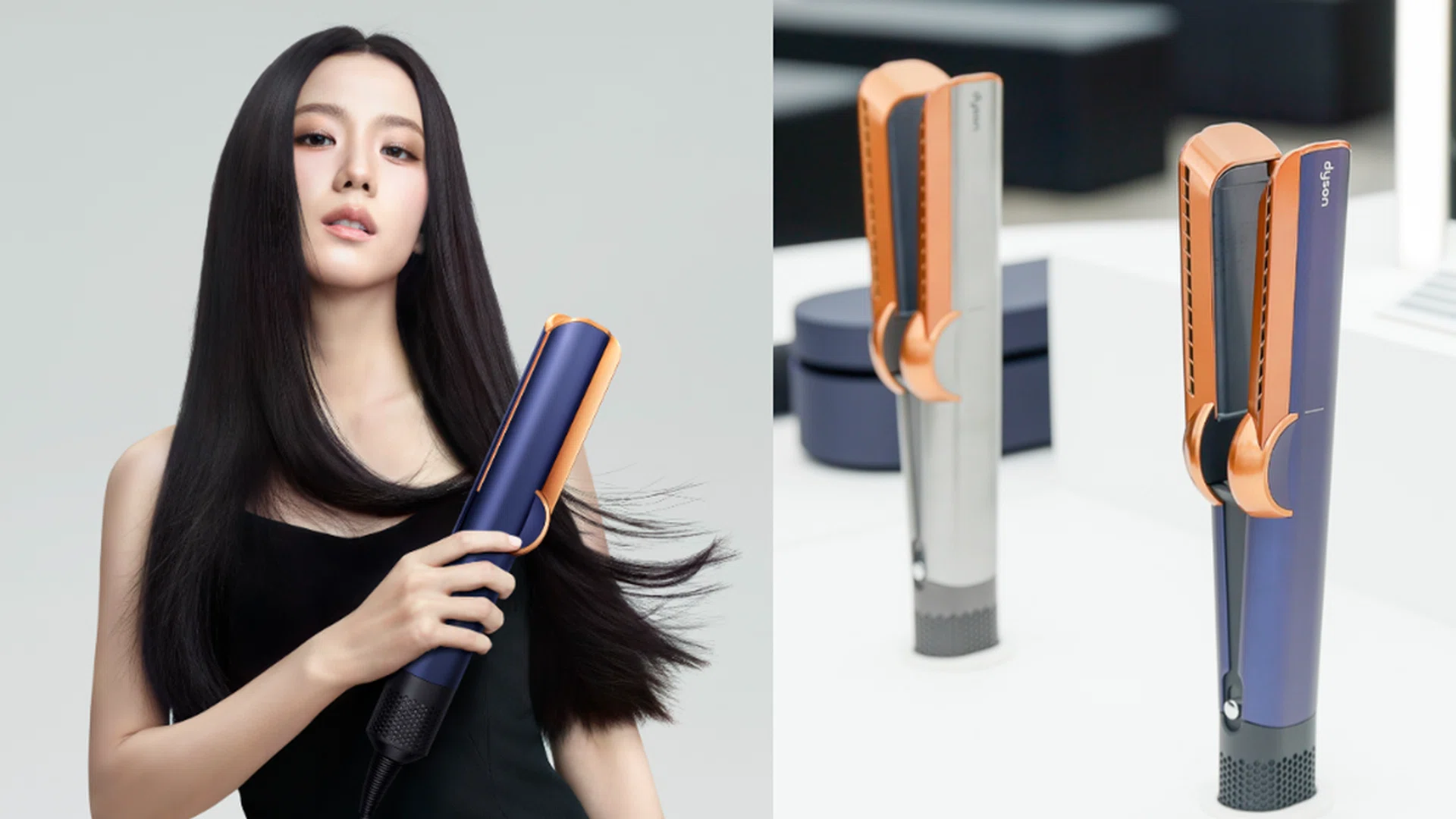
Share this article
| Overall verdict: The new Dyson Airstrait hair straightener uses its signature airflow technology to style wet hair with minimal damage while promising a salon-quality finish. There are cons — such as the large PRCD (portable residual current device) plug and the absence of universal voltage compatibility for traveling. However, overall it still excels in terms of user-friendliness and hair health. Retailing for $799, it is a more premium option for those looking for efficiency and haircare all in one product. |
|---|
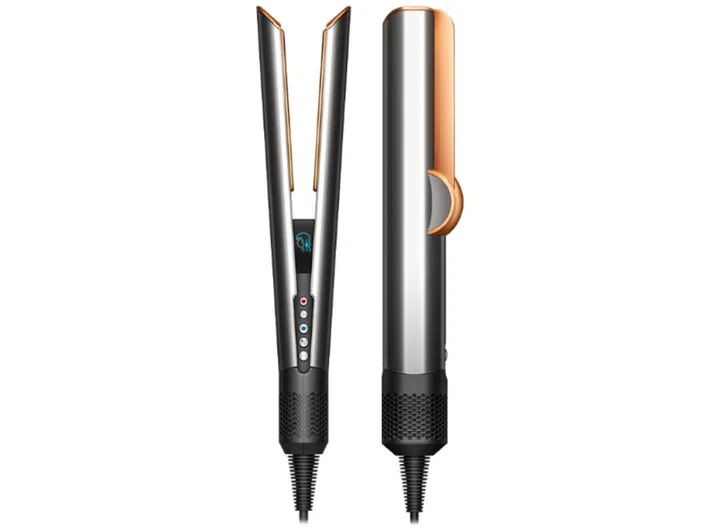
Credit: Dyson
Dyson's Airstrait could be the company's most game-changing hair product yet
When I first saw Dyson's latest hair care offering, the Dyson Airstrait straightener, my immediate feelings were of cautious optimism. On one hand, the promise of transforming my wet hair to frizzy-lessly straight in mere minutes without damage, seemed almost unbelievable. On the other, my experience with Dyson’s other hair straightener, the Corrale, was mixed – it was really cumbersome to use. But after using the Airstrait for the past few weeks, I’ve found myself surprisingly impressed with it.
Dyson’s obsession with hair health is renowned, and the Airstrait is another product that cements the company’s leadership in this field. You see, unlike conventional straighteners that use hot plates, the Airstrait employs what Dyson calls “precise directional airflow” to dry and smoothen hair. The science behind it involves breaking and resetting hydrogen bonds in the hair, which is easier to do when the hair is wet, allowing styling at lower temperatures.
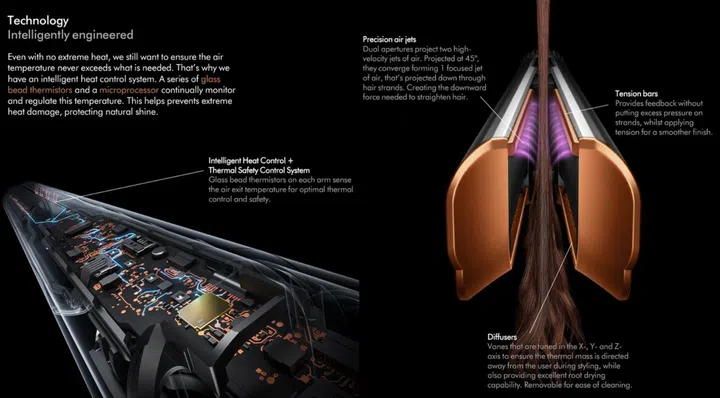
Credit: Dyson
To delve deeper into the science, when hair is wet, the hydrogen bonds within the strands are more malleable. Traditional styling tools use extreme heat to break and reset these bonds into a new shape. However, this can lead to significant heat damage over time. The Airstrait, by using a combination of controlled airflow and optimal heat, promises to minimise this damage while achieving the desired style. During a private demo session, one of Dyson's engineering team members told me that this method maintains the volume and movement of the hair better, which often gets lost with conventional straighteners.
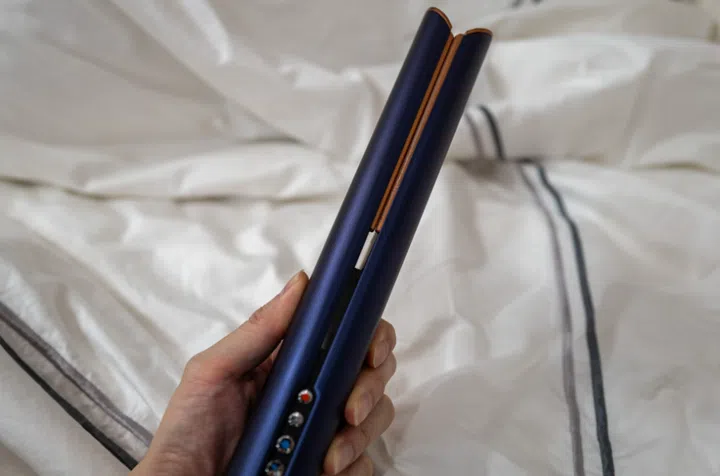
It might look like a flat iron hair straightener, except it's not.
Powering the Airstrait is the Hyperdymium motor – a smaller version of the ones used in the Supersonic hair dryer and company’s vacuum cleaners. The motor directs temperature-controlled air at a 45-degree angle to simultaneously dry and straighten hair. Essentially, it’s a hybrid blowdryer-straightener that can be used in two modes: when locked, it functions as a blowdryer; when unlocked, it resembles a straightening iron with air jets instead of plates. But if you’re thinking of retiring your Supersonic dryer for the Airstrait, be mindful that the latter can’t quite compare to the Supersonic in terms of power and heat, and you’ll also be giving up the attachments that come with the hairdryer.
There’s also an LED screen on the Airstrait, which allows easy switching between modes and airspeeds. The Wet mode offers three preset settings – 80, 110 and 140-degree Celsius – while Dry mode has 120 and 140-degree Celsius. Then there’s a Cool mode for setting styles, which I learned from the same Dyson engineer is key to keeping my hair straight for a longer period.
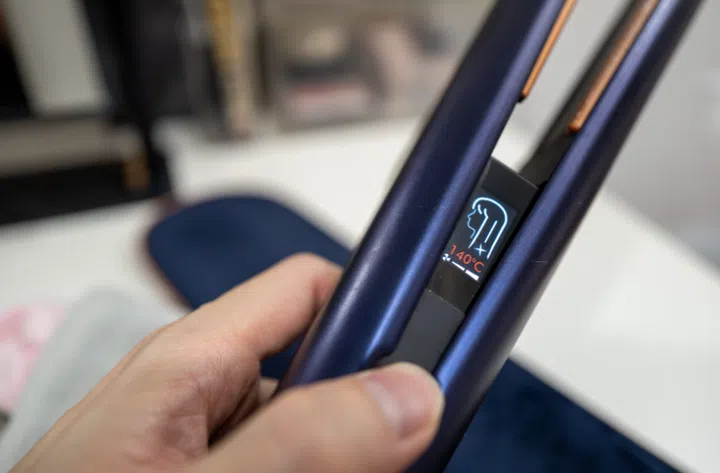
The Airstrait blows hot air at up to 140-degree Celsius.
The Airstrait is surprisingly user-friendly and easy to use right out of the box, and the button layout proves to be intuitive. When turned on, it goes through a 10-second cleaning process to clear the vents of dirt and debris to keep it clean.
Following advice from Dyson, I rough-dried my hair, especially the roots, in the locked position until it was about halfway dry. Then I took a section of my hair and placed it between the arms, clamped the AirStrait, and slowly moved the tool from root to end. Just one pass was enough to leave my hair dry, straight, and smooth. A second or even a third pass could set the hair better for some, though. I then repeat with other sections of my hair.
But perhaps what I like best about the Airstrait is how there was zero burning smell, which is a common issue with traditional flat irons. Thanks to built-in tension bars, the straighter also did not tug at my hair as I straightened it, avoiding the kind of tension that always feels uncomfortable (and painful at times) and causing hair and scalp damage. The Airstrait also never causes accidental scalding, even when in direct contact with my scalp or my ears (for those who straighten their hair, you’ll know what I’m talking about), thanks to a unique diffuser design.
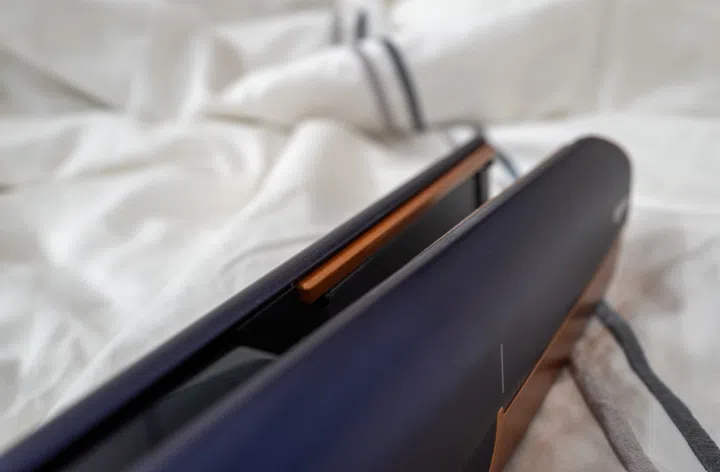
Built-in tension bars at the top minimises uncomfortable hair tugging.
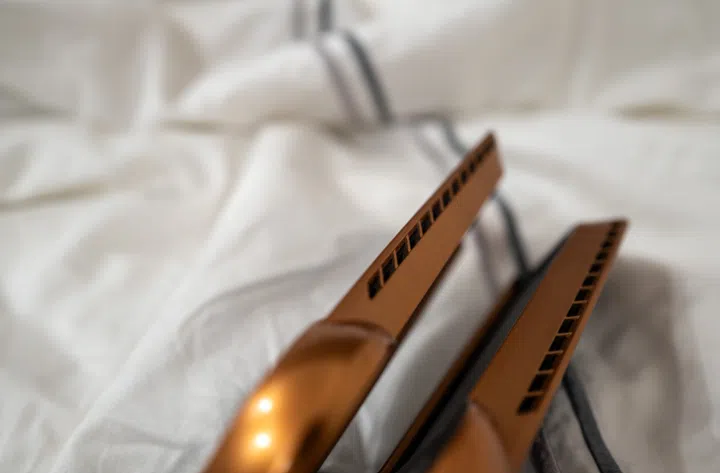
It will never cause accidental scalding thanks to the unique diffusers seen here.
After using it almost daily for the past few weeks, I’ve come to appreciate the ease of maintaining my hair and the time saved with the Airstrait – getting my hair sorted out takes just about 8-10 minutes on average, compared to the 30 minutes or so I would usually take with my Supersonic and Corrale. Perhaps more importantly, my hair does feel healthier and retains the shine since the Airstrait uses high-pressure airflow rather than hot plates, which does not damage hair like the latter does.
Still, there are a couple of things that I felt Dyson could have done better with the Airstrait. I’m probably nitpicking at this point, but the PRCD (portable residual current device) plug attached to the straightener is immensely huge. To be fair, Dyson says the PRCD plug is a safety necessity due to the Airstrait’s wet and dry use, and such plugs are common in electrical appliances that are close to water or water vapour. Still, I’m not a fan of such a big plug that’s permanently tethered to the Airstrait.
But perhaps my biggest peeve is that you can’t quite bring the Airstrait with you on overseas travels, as it’s not universally compatible with different voltages. So, your Singapore set can only be used in countries that support 220/240v and not in those that run on 100v. Like Japan or the USA, for instance. That’s a bummer because I really do like the Airstrait and it would make for the perfect travel hair care companion when looking good with minimal time spent is high on your personal priorities.
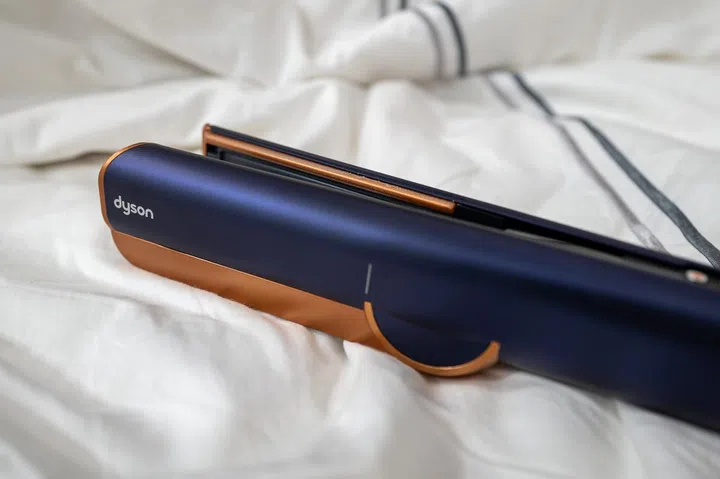
Despite some quirks, the Airstrait is the best hair straightener on the market. Period.
Yet, despite these minor quirks, I can’t recommend the Airstrait highly enough. The thoughtful design and advanced technology truly make it one of Dyson’s standout products, and despite the S$799 price tag, which some might feel is pricey, I believe there’s value in thinking of the time and money saved (from lesser visits to your hairdresser) with this purchase. It’s really a game-changer as a beauty and haircare product to be able to achieve a salon-quality finish in the comfort of your home and not harm your hair at the same time.
This article was originally published on Hardware Zone.