From Pregnancy To Menopause: Why Your Workouts Should Evolve With You
At Apex Training & Performance, personalised programmes help women like you stay strong as you move through different stages of life
By The Singapore Women's Weekly -

Share this article
In her 20s, Jassmin Peter-Bentzen always managed to keep to her dress size – even when she exercised less but ate more.
But as she entered her 30s, the mother of two young children saw her metabolism slowing down considerably, despite squeezing in three workouts a week alongside a busy work schedule. Then there was the tightness and pain on the left side of her neck and back, which started after she gave birth to her daughter five years ago at the age of 39.
At first, she attributed it to getting older. But when she spoke to Samantha Yeo, a post-natal and strength specialist at Apex Training & Performance, she realised the issue was something else. After years of repeating the same treadmill routine, her body had simply adapted to it.
“I remember Samantha telling me that when you do the same thing for years, your body eventually gets used to it,” Jassmin says.
Samantha is one of 11 trainers at Apex Training & Performance, a specialised personal training service for women aged between 35 and 55. Originally launched in 2021 to train professional athletes, Apex has channeled that performance expertise into its most meaningful mission yet: guiding women through the transformative life stages of IVF, pregnancy, post-natal and menopause.
According to fellow senior trainer at Apex, Christel Fung, a fat loss and pre/postpartum exercise specialist, it is common for routines to stop working as women’s bodies change over time.
“Women generally have about 20 per cent more joint ligament laxity, which affects range of motion and mobility,” she explains. “Hormonal rhythms and inflammation also fluctuate through menstrual cycles and as women age. All these factors influence how we plan individual training programmes for our female clients.”
On some days, that may mean adjusting a session to match how a client feels in the moment. If someone experiences hot flushes, for example, the workout might shift to slower stretching or recovery exercises.
A programme built around your life
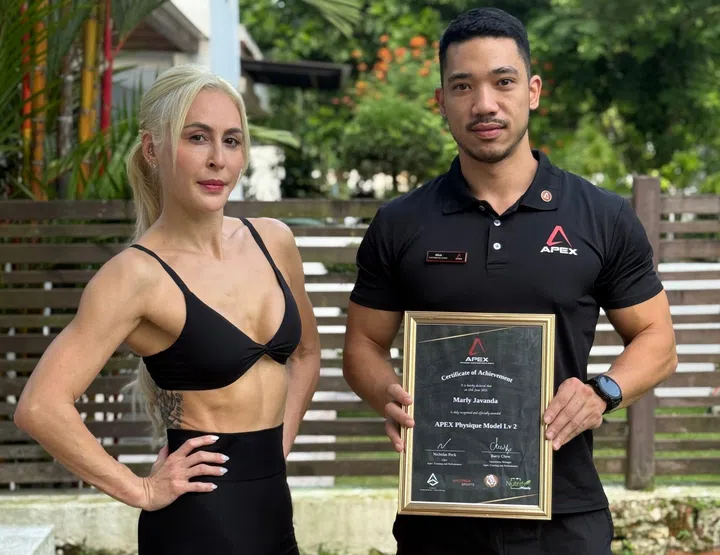
Before committing to Apex’s programme, Jassmin first had a consultation call with one of the company’s relationships managers.
The consultation call covered everything from her lifestyle habits and fitness goals to her personality, helping the team match her with a trainer who suited her needs and personality.
The goal, says Barry, training manager at Apex, is to ensure clients feel comfortable with their trainer so the relationship – and the motivation to train – lasts.
“You don’t want the client to feel, ‘Oh no, my trainer is coming again,’” says Barry. “It’s about understanding what they want and building something that lasts.”
In Jassmin’s case, she was paired with Samantha, a former national swimmer known for her upbeat energy.
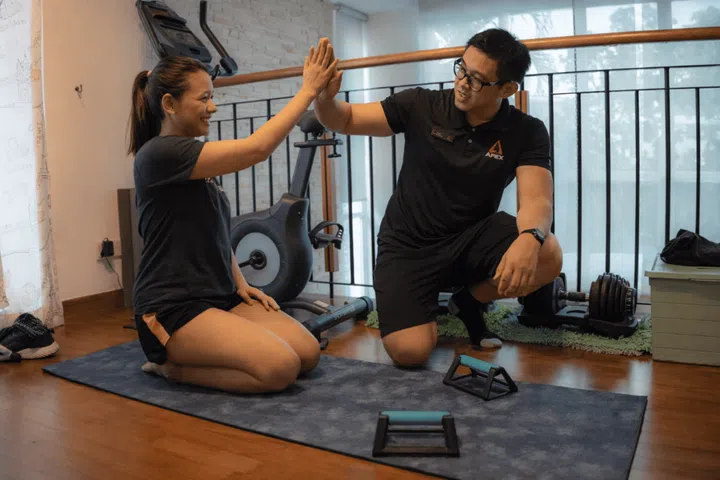
Unlike most fitness programmes, the team at Apex trainers do not require a gym. Instead, they travel to clients – meeting them at their condominium gym, the outdoor fitness station at their HDB estate, or even in their own living rooms.
By trainers meeting at clients’ convenience, Apex removes some of the barriers that might make regular exercise inconvenient, especially for busy women or post-natal women.
“Some clients have no time to travel to gyms,” says Nicholas Peck, founder of Apex. “Others feel intimidated or uncomfortable by the unfamiliar surroundings. We try to make training as accessible and comfortable as possible.”
Discovering what your body really needs

One weekday morning, Samantha arrived at Jassmin’s home, equipped with bands, light weights and other equipment, for a productive session to take place.
They started by talking. Samantha walked Jassmin through a comprehensive interview – her goals, her lifestyle, what a typical week looked like – and together they reviewed her blood work, giving Samantha a full picture of Jassmin’s health before moving into a series of exercises.
“We discussed knee pain and the things that come with entering your 40s,” Jassmin says. “Samantha also taught me how to be more aware of my body through exercises that were easy to understand and I could practice on my own.”
During the session, Jassmin mentioned a nagging tightness on the left side of her neck and back that had started after her daughter was born.
She had always assumed the discomfort came from weakness on that side. But after observing her move through a few exercises, Samantha noticed something else.
“My right side was actually weaker,” Jassmin recalls. “So I had been overusing my left side without realising it. My weight wasn’t evenly distributed and I wasn’t engaging my core.”
The one-to-one format meant Samantha could correct her form immediately.
“When I kept leaning towards the left with my kettlebell, she reminded me to move back to the centre,” Jassmin says. “In group classes, the instructor may not have time to catch those details.”
Support beyond the workout
Coaching doesn’t stop when the session ends.
From the moment a client signs up, the team at Apex creates a WhatsApp group that includes the trainer, the training manager and the client. It becomes a private space where the journey continues between sessions.
“Clients share what they had at meals, ask questions, check in when they need support or simply update us on how they’re feeling,” explains Barry. “Whether it’s quick nutritional guidance, feedback on meals or encouragement on a busy day, the team is always there.”
“It’s this constant connection that helps clients stay consistent, supported, and confident — knowing they’re never navigating the process alone,” adds Nick.
For Jassmin, that meant sending photos of her meals. “Samantha asked me to place my palm next to my dishes so she could see the portion size,” she says, adding that her trainer would also ask about the ingredients and check in on her afternoon snacking habits.
Still, the goal is not strict dieting.
For example, when Jassmin shared that she usually has chia seeds, granola and bananas with oat milk for breakfast, Samantha simply asked if she might consider trying soy milk instead because it contains fewer carbs due to her lower activity level for that day.
“We try not to make clients go cold turkey,” says Nick. “We don’t want them to develop a bad relationship with food.”
Trainers may also suggest additional bloodwork tests that clients can include in their routine health check-ups, helping them better understand what is happening in their bodies.
Fitness that evolves with you
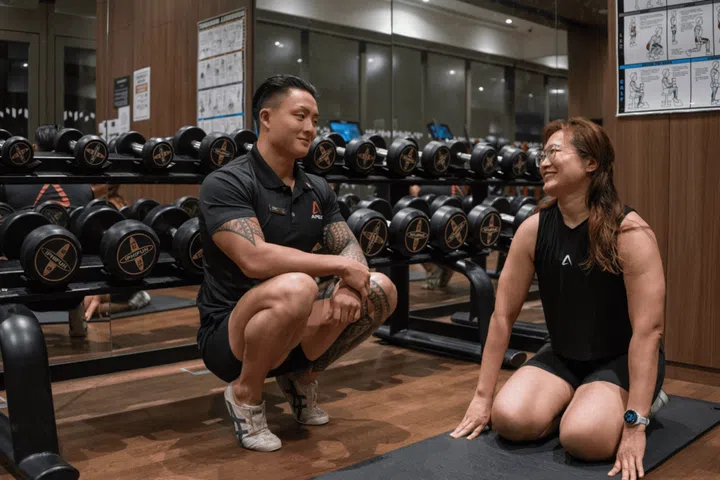
Many Apex clients join the programme at moments of change.
Some are navigating perimenopause and finding it harder to maintain the same energy levels or body composition. Others are preparing for childbirth, working on breath control and endurance that may help with a smooth delivery.
After delivery, trainers often help new mothers rebuild core strength or address issues such as lower back pain and diastasis recti – the separation of abdominal muscles during pregnancy.
At Apex, the goal is always to meet each client where she is.
“Maybe your goal is to carry your newborn out of the crib without hurting your back,” Samantha says. “Maybe you just want to get your energy levels back. Everyone is at a different stage of life.”
One client started with a much simpler goal: She wanted to go hiking but struggled with lower back pain.
After a year of training, she now participates in marathons and Hyrox competitions.
“And she’s constantly riding a health high,” says Samantha.
Learn more about Apex Training and Performance’s personalised, at-home training programmes at www.apextrainingandperformance.com and @apextrainingandperformance.