A Breezy, Multi-Generational Landed Bukit Timah Home Designed For Family Interaction
Unconventional features in this house help keep it cool and well-ventilated for its multi-generational family of six
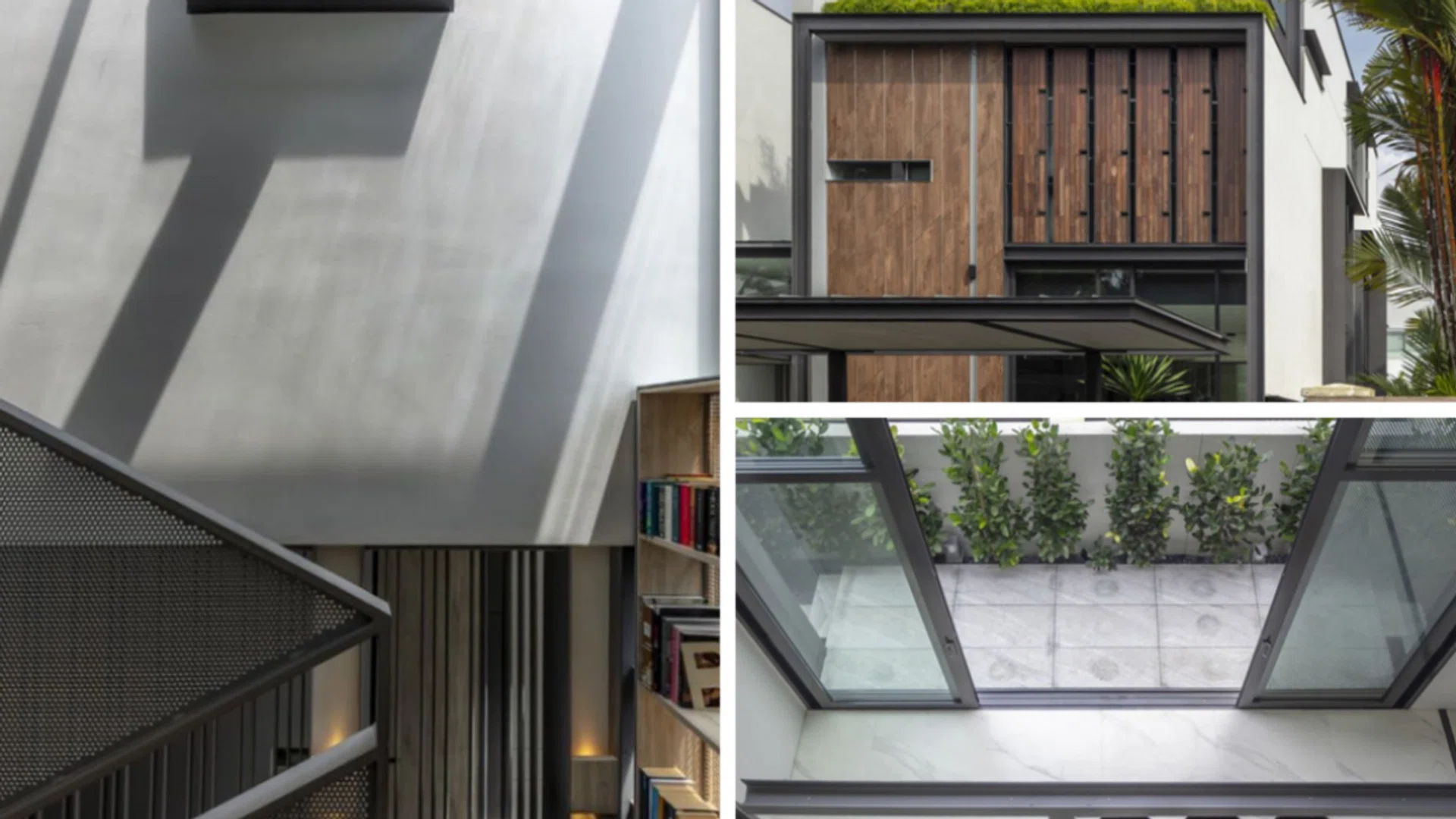
When the homeowners of this two-and-a-half storey home in Bukit Timah tasked RT+Q Architects with its design, the brief was a straightforward one. “We asked for a well-ventilated home that would encourage interaction between family members,” says the wife, who lives with her husband, their three kids and her mother-in-law. The couple are both traders.
The family had previously lived in two apartments, with the grandmother on her own, but “we decided to build a multigenerational home, so that we can all be under the same roof,” says the wife.
A spokesman from RT+Q Architects says that apart from the client’s brief, “the project presented an opportunity for us to explore the idea of a ‘free section’ where spaces flow vertically in a fluid manner”.
AT A GLANCE
Home: Two-and-a-half-storey landed home in Bukit Timah
Who lives here: A couple, three kids, and the husband’s mother
ID: RT+Q Architects
A typical tropical home tends to have a pitched roof and huge overhanging eaves as a way to keep the house cool in Singapore’s hot and humid weather. But there is none of that in the 5,700 sq ft home.
“We adopted a “abstract tropical” typology,” says the spokesman. That translates into lots of open and double height spaces throughout the house, which promote cross ventilation. On a cool day, a breeze flows gently throughout the house and the family can do away with air-conditioning. The open spaces also serve as common areas for the family to gather.
While the family entertains guests in the conventional living room, it’s the dry kitchen and informal dining area at the back of the house that are the main features of the first floor. The family members cook and have their meals in this is two-storey high space, and the high ceiling instantly makes it look bigger and also cooler. In addition, the double-height sliding doors add a touch of grandeur to the space.
For extra cross ventilation on the upper floors, the staircase is constructed from steel structures with porous steel screens and open bookshelves at each landing, instead of solid walls.
There’s another double height space, this time on the second floor, outside the bedrooms for the children and their grandmother. The space, a study area for the children, aged seven to 13, is designed to overlook the informal dining area. “We can see who’s downstairs from here,” says the wife. “And when I’m at the dining table and want to call the kids, I simply shout and they can hear me from upstairs.”
A steel framed rectangular porthole in the grandmother’s bedroom creates a connection from her private space to the common areas, with a swivel panel to close it off when privacy is needed. “We wanted to add a touch of fun to the room, and the window helps in cross ventilation too when it’s open,” says the spokesman.
Meanwhile, fluted glass peepholes at the children’s bedroom allow for some visual connection into the rooms without compromising on privacy.
Above the countertop in the open study area is a black rectangular box that protrudes from the wall. It is an unexpected structure, and one that always draws questions from visitors. “They wonder what it is, but they only find out when they go up to the attic,” says the wife with a smile.
The couple located their bedroom in the attic, which is also the wife’s favourite place in the home, “because it feels like a one-bedroom apartment here”, she says. Besides the usual sleeping area, bathroom, walk-in wardrobe, there is also a spacious terrace at the front.
The key feature is the bathroom, specifically the box-like shower area. Not only is it placed in between the his and hers toilet, but this black box is the same one that is seen on the second floor. “We wanted to do something different from the conventional bathrooms,” says the spokesman, of the cantilevered shower area.
While the house employed features such as open and double height spaces to keep it cool, the use of materials also play a part.
Most homeowners favour the use of timber for its warmth, but not for this couple. In fact, the only real wood used is on the facade for privacy and sun shading.
Instead, the owners chose homogeneous tiles for the first floor for their easy maintenance, and terrazzo tiles for the upper floors. “Tiles are cooler to touch than parquet floors,” says the spokesman.
As the building has a side attached to its neighbour,the challenge was how to bring natural light into the home. The team at RT+Q Architects counters this problem by creating a small but sufficient open-air courtyard on the first floor, as well as putting in skylights at the couple’s walk-in wardrobe area and bathroom. The use of fluted glass, in place of solid walls, around some areas of the home, also help bring in more light while providing privacy.
The family is pleased with their new home, as it ticks all their boxes. “We plan to live here for a long time,” says the wife.
Text: Tay Suan Chiang/The Business Times