Still Have A Mum Tum? It Might Be Diastasis Recti
If your belly still feels soft or domes months after birth, it could be diastasis recti. The good news: with proper guidance, recovery is possible
By Kelly Ang -
Share this article
Heard the term diastasis recti after pregnancy and wondered if it could be the reason behind your persistent post-baby belly? Turns out your friend’s friend — and yes, maybe even Google — may be right this time.
Diastasis recti, also known as abdominal separation, is common after childbirth but not spoken about enough. And while it can show up as a lingering belly bulge or “doming” around the abdomen, it is not just a cosmetic concern. In some cases, it can affect posture, core strength, pelvic floor function and overall quality of life.
We ask three experts how to spot diastasis recti, what causes it, and what can help you heal safely.
Our panel of experts
- Dr Carmen Tong, consultant, department of obstetrics and gynaecology, KK Women’s and Children’s Hospital (KKH)
- Dr Marco Faria Correa, medical director and plastic & cosmetic surgeon, Dr Marco Faria Correa Plastic Surgery
- Ms Jenna Kee, principal physiotherapist, KKH
Quick answer: what is diastasis recti?
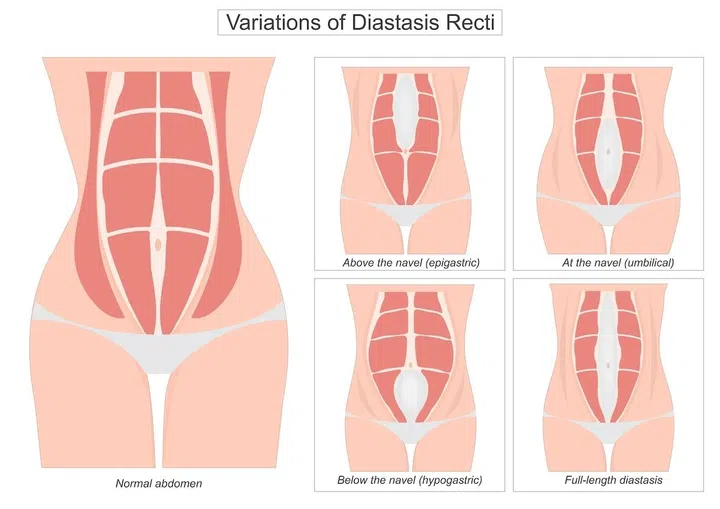
Diastasis recti is the separation of the left and right abdominal muscles, often caused by pregnancy as the uterus expands and stretches the connective tissue between the muscles. Common symptoms of abdominal separation include a persistent belly bulge after childbirth, doming during sit-ups or crunches, a soft or jelly-like gap near the belly button, lower back pain and core weakness.
Mild to moderate cases may improve with physiotherapy and safe core exercises. More severe cases may need medical review, and in some situations, surgical repair may be recommended.
What is diastasis recti?
Diastasis recti (say “die-uh-stay-sis rek-ty”) refers to the vertical separation of the abdominal muscles, also known as the rectus abdominis. Some medical professionals may also call it diastasis of the rectus abdominis muscle, or DRAM.
Explains Dr Carmen Tong, consultant at the department of obstetrics and gynaecology, KK Women’s and Children’s Hospital (KKH): “The rectus abdominis muscle, commonly known as the six-pack muscles, is normally joined in the centre by a strip of connective tissue called the linea alba. During pregnancy, the uterus expands, causing the linea alba to stretch. Elevated pregnancy hormones also cause the connective tissues of the linea alba to thin and stretch.”
“It is actually normal to experience midline separation in the postpartum period. Usually, the muscles and connective tissue regain strength when the core muscles are re-engaged after childbirth. However, if this gap remains wider than roughly two finger-breadths and the connective tissue stays persistently lax, it is considered to be diastasis recti.”
Diastasis recti symptoms: what it looks and feels like
So what does diastasis recti actually look and feel like in real life?

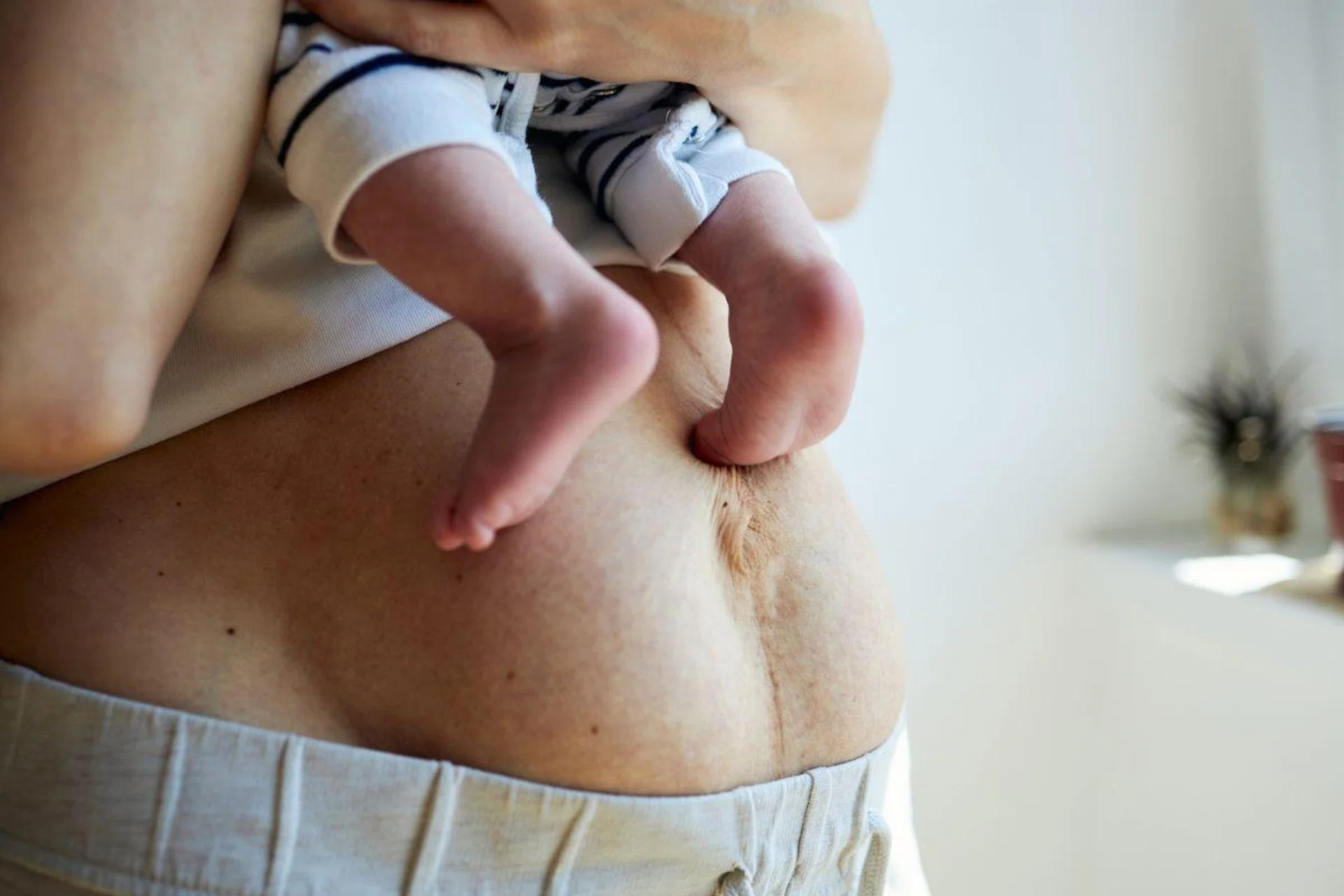
Diastasis recti often appears as a protrusion around or just above the belly button — what many people casually refer to as a stubborn post-baby belly.
Other common signs include a soft, jelly-like feeling around the belly button, lower back pain, core weakness, and doming along the midline of the abdomen when you attempt crunches, sit-ups or other movements that strain the abdominal muscles.
How common is diastasis recti after pregnancy?
Diastasis recti after pregnancy is more common than many women realise.
Studies suggest that diastasis recti is very common during and after pregnancy, although prevalence varies depending on how and when it is measured. One study found prevalence rates of 60 per cent at six weeks postpartum, 45.4 per cent at six months and 32.6 per cent at 12 months postpartum. Another study found rates falling from 100 per cent at 35 weeks of pregnancy to 39 per cent at six months postpartum.
In other words, some degree of abdominal separation during pregnancy is expected, as the abdominal wall stretches to accommodate the growing uterus and baby. For some women, the separation improves naturally after delivery, leaving a much smaller gap or no significant gap at all.
However, if you have a gap of more than 3cm, persistent symptoms, or concerns about abdominal separation after pregnancy, it is best to seek professional advice from an OBGYN or a physiotherapist specialising in women’s health.
Preventing diastasis recti: can you reduce your risk?
Given how common abdominal separation can be during and after pregnancy, does it mean you are resigned to fate?
Not necessarily. While diastasis recti may not be 100 per cent preventable, there are steps that may help reduce the likelihood or severity of abdominal separation.
The basics matter: managing weight gain as advised by your OBGYN, maintaining good posture, practising deep breathing techniques, moving carefully, and strengthening your core safely.
Before pregnancy: Maintain a healthy weight and strengthen your core
During pregnancy: Practise good posture, move carefully to avoid abdominal coning, modify workouts to safe, low-impact routines, and use a belly band for support if advised
First year after childbirth: Focus on rest, recovery and gentle core strengthening that does not cause coning
One year after childbirth and beyond: Continue with core strengthening, posture correction and healthy lifestyle habits
How to minimise diastasis recti during pregnancy
While many women develop some abdominal separation during pregnancy, certain everyday habits may help reduce the severity.
Ms Jenna Kee, principal physiotherapist at KKH, points out that some regular daily activities can inadvertently worsen DR, and that paying attention to them can help mitigate the severity of the separation.
She recommends maintaining a good posture, practising proper body mechanics such as rolling to the side when getting up from bed, using a correct lifting technique when carrying weight, avoiding straining during bowel movements, and managing weight gain as recommended by your OBGYN to minimise stretching in the anterior abdominal wall.
“In later pregnancy, you may want to consult a physiotherapist for individualised assessment and guidance on safe abdominal exercises to improve core strength, and engage in gentle abdominal exercises focusing on the deep abdominal muscles. Avoid crunches or movements that cause a visible bulge along the abdomen,” she says.
Both Ms Kee and Dr Marco recommend wearing a maternity support belt to help support the growing abdomen, especially in the last trimester when DR tends to worsen due to hormonal changes loosening the ligaments to allow the pelvis to expand for childbirth.
Can you get diastasis recti without being pregnant?
Yes. Because diastasis recti is essentially the separation of abdominal muscles, it can happen to anyone — including men, women who have never been pregnant, and children.
People who are overweight, who suffer from chronic constipation or chronic coughing, or who do not engage their core properly when lifting weights may have a higher risk of developing DR. Ageing abdominal muscles that become weaker and lose elasticity can also make the midline more prone to thinning and strain.
Post-menopausal women may also be more prone to developing DR, as hormonal changes can reduce muscle strength and elasticity.
Some infants are born with DR, especially premature babies whose muscles are still underdeveloped. This may appear as a ridge in the middle of their belly. In most cases, the separation closes on its own as the baby’s muscles develop.
How to check for diastasis recti at home
A bulging belly can be one sign of diastasis recti, but it is not the only sign. It also does not mean you definitely have DR just because your belly looks or feels different after childbirth.
A simple home check can give you an idea of whether you may have diastasis recti, although a doctor or physiotherapist can assess it more accurately.
Here’s how to check for abdominal separation at home:
- Lie down on your back with your knees bent and your feet flat on the floor.
- Lift your shoulders slightly off the ground, as if you are doing a small sit-up, and look at your belly.
- Place one hand above your belly button area. Use your fingers to feel for a gap between your abdominal muscles. See how many fingers can fit in the gap. If you feel a gap of two or more fingers, you may have DR.
Some women may search for “3 fingers diastasis recti” after doing this self-check. A wider or deeper gap, especially one that comes with doming, pain, weakness or difficulty with daily movements, is a good reason to seek professional help.

Dr Marco, medical director and plastic & cosmetic surgeon at Dr Marco Faria Correa Plastic Surgery, who has helped thousands of women with their DR, advises women to look out for a gap around the belly button. His trick? “Spotting a bulging sausage-like appearance in the midline when doing a small sit-up.”
If you still cannot find the gap yourself (trust us, it is much easier said than done!), your best bet is to get assessed by a qualified physiotherapist specialising in maternity and postpartum recovery.
You can also ask your OBGYN about diastasis recti at your postpartum check-ups.
“Diagnosis is based on clinical assessment during their postpartum check-ups. The patient lies on her back with bent knees and lifts her head slightly, and tuck her chin to her chest, while we feel along the midline of her abdomen. This helps to gauge the width of the gap between the rectus muscles. If the gap feels wider than two finger-breadths, or if she has clinical symptoms, we will discuss the option of postnatal physiotherapy,” says Dr Tong.
Because a DR-related belly bulge can look similar to belly fat, you may also try gently pinching the area. Belly fat tends to feel like a firm, continuous roll. Diastasis recti, on the other hand, is usually associated with a gap in the middle of the abdominal muscles, which may feel softer or more hollow when you press into it.
Will my gynaecologist check for diastasis recti?
For many postpartum women, their OBGYN is the first doctor they see after delivery. While not all OBGYNs routinely check for diastasis recti, you can and should ask if you are worried about it.
Says Dr Tong: “Many patients do bring up these concerns themselves. When patients attend their postnatal check-ups at KKH, their symptoms are evaluated. Some degree of midline widening is normal as the womb grows during pregnancy, but if they have persistent symptoms such as core weakness, back discomfort, or a persistent bulge months after birth, we will check to see if the midline separation is functionally significant.”
Why diastasis recti is more than a cosmetic concern
If you are all about embracing your new mum bod, good on you. But diastasis recti is not something you simply have to accept as part of motherhood — especially if it is affecting your comfort, strength or daily life.
It is also not just a cosmetic concern.
“While DR is not medically dangerous in most cases, persistent or severe DR can definitely impact your quality of life,” says Dr Tong. “Core instability and back pains, gastrointestinal problems such as bloating and constipation, and emotional distress are all issues that can be caused by DR.”
Additionally, untreated and severe DR can be associated with pelvic floor function issues, which may lead to problems with bladder, bowel, and sexual function.
Dr Marco explains: “When the anterior abdominal wall is weak due to DR, the pelvis tends to tilt forward, which can misalign the pelvic floor muscles. This affects the pelvic floor muscles’ ability to support the organs inside the pelvis properly.”
Can diastasis recti be treated?
The good news is that diastasis recti can often improve with the right support, especially when the gap is mild to moderate.
For many women with gaps that are less than 6cm, guided home exercises and physiotherapy may help reduce the gap, strengthen the abdominal muscles and improve core function.
Says Dr Marco: “For mild to moderate cases (3-4cm gap), some patients can manage well with proper physiotherapy, yoga, or pilates under an experienced instructor.”
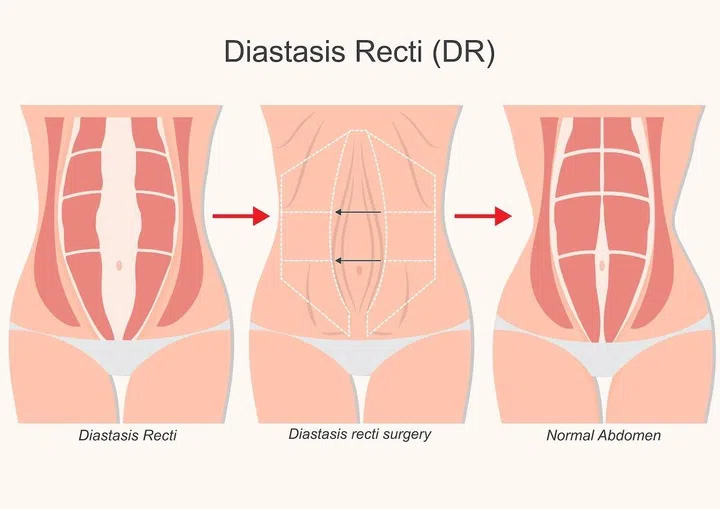
For some women with wider gaps or persistent symptoms, surgery may be needed.
“When the diastasis is very large (typically more than 6cm), physiotherapy alone often isn’t enough and a professional physiotherapist may recommend surgical repair, during which the rectus diastasis is stitched together using a strong and layered stitching technique,” he says.
However, Dr Marco cautions that for the surgery to be effective, it is important for the patient to avoid strenuous activity for six months post-surgery to let the scar and muscle heal well.
He advises patients to continue with physiotherapy, to re-educate the posture, engage the muscles correctly, and protect the spine. “Treating rectus diastasis is multidisciplinary — it’s about surgery plus physiotherapy for optimal results.”
Best exercises for diastasis recti (and what to avoid)
For mild to moderate DR with a gap of 3cm to 4cm, certain exercises may help strengthen the abdominal muscles and reduce the gap.
Ms Jenna Kee, principal physiotherapist at KKH, shares the following exercises that women can do at home.
She cautions: “You should still monitor to ensure that there are no visible bulges along the abdomen during or after exercise.”
DO: Exercises that may help diastasis recti
Exercises that strengthen the transverse abdominis (TVA) muscle — the deepest abdominal muscle in your core — may help support DR recovery over time.
It is also important to strengthen the pelvic floor and diaphragm, so that your abdominal muscles are properly supported as you exercise.
Diaphragmatic breathing
- Lie down or sit upright. Place one hand on your abdomen and the other on your chest.
- Breathe in slowly through your nose, allowing your tummy to rise.
- Exhale slowly through your mouth, letting your tummy fall.

Deep abdominal drawing-in manoeuvre
- Lie on your back with your knees bent.
- Gently draw your lower tummy towards the spine.
- Hold for five to 10 seconds while breathing normally, then relax.

Pelvic tilt
- Lie on your back with your knees bent.
- Gently flatten your lower back into the floor. You should feel your pelvis tilt slightly upwards and your lower tummy tighten towards the spine.
- Hold for five to 10 seconds while breathing normally.
- Return to starting position.

Moderate-intensity aerobic exercise
Aim for a total of 150 minutes per week to help with weight management. Suitable options may include:
- Long-distance or brisk walking
- Stationary cycling
- Swimming or water aerobics
AVOID: Exercises that may worsen diastasis recti
While your DR is still healing, some movements can increase intra-abdominal pressure and worsen abdominal separation. Avoid these until your gap has reduced and your abdominal muscles have regained their strength, or until your physiotherapist advises that it is safe to resume them.
- Sit-ups or crunches
- Twisting sit-ups or bicycle crunches
- Full planks or push-ups
- Leg raises or flutter kicks
- Heavy lifting without core engagement
Can diet help with diastasis recti?
Because diastasis recti is a core and connective tissue issue, dieting alone will not close the abdominal gap or get rid of a belly bulge caused by DR.
That said, good nutrition can support your overall recovery. A healthy, balanced diet rich in fresh fruits, vegetables and whole, unprocessed foods can help your body heal.
Experts recommend eating a diet high in vitamins A, C, E and zinc, which help with tissue repair and minimise inflammation.
When should I seek help for diastasis recti?
If you suspect you have diastasis recti, a home check may help you decide whether to seek further advice. But if you are unsure, symptomatic or worried, it is best to see a professional.
Ms Kee recommends women to seek professional help from a physiotherapist that specialises in women’s health, if they experience the following:
- No noticeable improvement in the abdominal gap after a period of self-guided home recovery
- A large or deep gap detected during self-assessment
- A visible bulge along the abdomen during self-assessment, daily activities or exercise
- Difficulty performing daily activities such as getting out of bed or lifting a baby
- Lower back / pelvic pain affecting their daily activities
- Urinary incontinence during their daily activities
Untreated DR may worsen, especially if you continue to engage in exercises such as crunches, sit-ups or Russian twists that strain the abdomen and increase pressure on the linea alba.
In extreme cases, untreated DR can affect the entire physiological system, warns Dr Marco. He shares: “Complications include respiratory, urinary and spinal issues like intervertebral disc prolapse or hernias, or uterine or bladder prolapses.”
Where to get help for diastasis recti in Singapore
If you suspect that you have diastasis recti, you can ask your OBGYN to check for abdominal separation at your next postpartum appointment. If needed, you may be referred to a physiotherapist who specialises in women’s health. They can assess the extent of separation and guide you through exercises to support recovery over several sessions.
Home exercises will also be important between physiotherapy sessions and even after they end.
Yoga or pilates instructors who are well-versed in pelvic floor health and postpartum recovery may also help support your recovery, especially if they understand how to modify movements for diastasis recti.
For severe cases, you may be advised to see a plastic surgeon, who can repair the abdominal muscles through open abdominal surgery or minimally invasive surgical methods such as laparoscopic or robotic surgery.
You can approach physiotherapists or plastic surgeons in public hospitals such as KKH, or private practices such as Dr Marco’s clinic.
Will diastasis recti return if I get pregnant again?
Yes, it can. A subsequent pregnancy, significant weight gain or strain on the abdominal wall may affect a previous repair or widen the gap again.
It is generally advisable to wait until after you are done having babies before undergoing surgical repair for diastasis recti. However, that does not mean any repair done earlier is necessarily wasted.
“We see some patients who become pregnant again or even gain weight after their diastasis repair surgery. But for most of them, adhering to a six-month recovery period with minimal strenuous exercises or strain to the abdomen, has helped the scar to mature and keep the stitched muscle strong and stable,” reassures Dr Marco.
Even if you do not undergo surgical repair because you are still planning for another baby, it is still worth working on your core and pelvic floor strength with safe exercises and physiotherapy.
This may help reduce the severity of DR in a future pregnancy, and make it easier to recover from abdominal separation later on.
Can diastasis recti heal without surgery?
If you are hesitant to go for surgery and want to improve your DR through non-surgical methods, Ms Kee offers this reassurance: “You do not need to have no gap to be normal. In general, a healthy abdomen after childbirth can have a gap of up to 2cm (approximately one finger’s width) without associated symptoms such as lower back / pelvic girdle pain, urinary incontinence or abdominal hernia.”
In other words, recovery is not always about achieving a completely closed gap. It is also about whether your core feels functional, supported and symptom-free.
Will my belly bulge go away after treating diastasis recti?
Treating diastasis recti and improving your core strength may help reduce the appearance of a belly bulge. However, if your bulge does not completely disappear even after DR has improved or been repaired, don’t despair.
Loose skin and some stubborn fat also contribute to a persistent tummy, which is completely normal after carrying and growing a baby in your body for nine months.
Be patient with yourself, and don’t sweat the changes.