How This Funeral Director Talks To His 3 Young Kids About Death
By talking about death with his children, the chief executive of Direct Funeral Services hopes they will cherish life and relationships
By Elisa Chia -

Share this article
How do you talk to kids about death? Coping with the death of a loved one is always challenging. But for parents with young children, the situation becomes even more daunting as they must also help their little ones understand the loss and process their feelings.
Mr Darren Cheng, who has three kids aged four, six and seven, knows this all too well. In 2019, the younger of his two sisters, Cheng Cai Yi, was suddenly diagnosed with leukaemia. She died from the illness in 2022 at the age of 30.
As the chief executive of Direct Funeral Services, he has supported grieving families. “I have helped many clients process loss. When it came to my turn, my loss wasn’t any less painful, but it was more manageable,” the 40-year-old says.
His kids would pick up on his sadness and ask him why. “I told them it was because of their xiao gu (Chinese for youngest aunt),” he recalls. Grief sometimes made him short-tempered too.
As the heartache of losing his sister eased over time, he decided to write a picture book to explain loss and grief to his children and others.
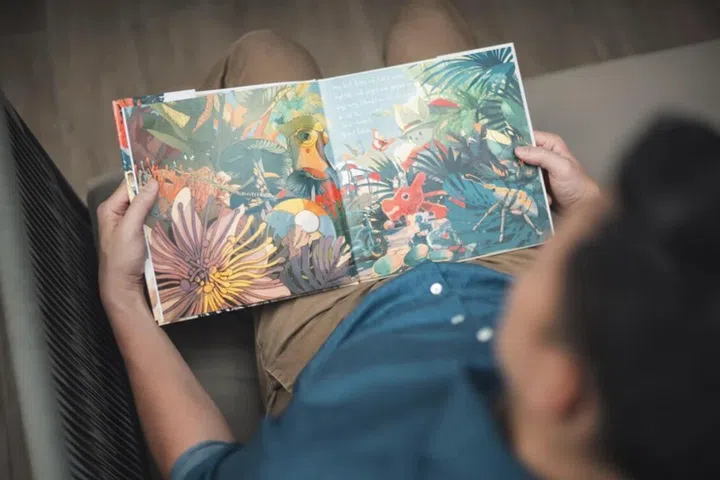
While this is his third book for children on the subject of death, The Colours Of Missing You is more personal. Launched in August, it tells the story of a girl navigating an emotional roller coaster after her best friend’s death.
Mr Cheng’s work draws on the five stages of grief outlined in Swiss-American psychiatrist Elisabeth Kubler-Ross’ 1969 book On Death And Dying. Famously known as the Kubler-Ross model, these stages – denial, anger, bargaining, depression and acceptance – represent a pattern of adjustment to loss.
Mr Cheng expanded on the stages, using the rainbow’s seven colours to better explain the strong waves of emotions that come with loss.
Red, for example, signifies anger, while blue is for overwhelming sadness. He added an eighth colour, grey, to symbolise denial.
He enlisted Shanghai-born, London-based artist Shan Jiang, whose work he admires, to illustrate the pages.
Mr Cheng is also the co-author of Where Did Grandpa Go?, which was released in 2015, and I Remember Grandma in 2019.
These are published by the funeral company’s giving back unit Direct Life Foundation, which he co-founded with his wife Jenny Tay. Madam Tay, 39, is also the managing director of Direct Funeral Services.
But Mr Cheng’s first foray into children’s writing was in 2011 when he was a psychotherapist. He worked with mostly kids and teenagers for 10 years and self-published A Bowl Full Of Ice Cream, a collection of short stories to inspire change in them.
His four books, with prices starting at $18, can be purchased from the couple’s flower and gift store Flower Story (str.sg/3CGMs)
While death is often considered a taboo subject, Mr Cheng says it is important to demystify it with kids. Besides helping them manage their emotions when such situations arise, these conversations also encourage them to cherish and spend time with their loved ones.
Mr Cheng has a bachelor’s degree in psychology from the National University of Singapore and a master’s in counselling from Swinburne University of Technology in Melbourne. He shares more about how to navigate this topic with children.
How do I explain death to a young child?
At the funeral of a friend’s father, Mr Cheng overheard a boy ask where his late grandfather was going. The boy was simply told: “Ah gong is going to a big oven in Mandai (Crematorium) where he will be burnt and sent to heaven.”
Drawing on his counselling background, Mr Cheng thought it was not a good explanation for the child.
That incident inspired him to write Where Did Grandpa Go?, which offers a gentle and imaginative approach to addressing the topic.
In the story, Grandpa tells young Joshua that he may be leaving soon to a place where he will be “young again and have a full head of hair”.
Grandpa dreams of exciting adventures, such as swimming with polar bears and exploring outer space. Most importantly, he makes sure Joshua knows he will always be in his heart, no matter where he goes.
A simple tale like this, Mr Cheng says, can bring comfort to pre-schoolers and even adults who are dealing with loss, as they imagine their loved one is in a beautiful, faraway place – and happy.
For kids who are saddened by a loved one’s illness and passing, how can I offer support?
Let them ask questions, talk to them and simply be there.
Mr Cheng recalls: “My eldest child was very young when my sister got diagnosed with leukaemia. Whenever my kid showed signs of curiosity, I’d share with her what was happening in our family, what xiao gu was going through and how I was feeling.”
He also gently prepared her for the idea that her aunt might not be with them for much longer.
Depending on how intense the grief is, sometimes a good cry together can make a difference, says Mr Cheng.
“As Asian parents, we don’t usually cry in front of our kids. Some even tell their kids that they have to stay strong and not shed tears.”
But letting your feelings out is an important part of grieving. Healing can truly start when you let yourself fully express those emotions, he adds.
But I feel uncomfortable discussing loss and grief with my kids. Why start these conversations early?
Grief hits everyone, no matter their age, and it is not solely associated with death. Kids may grapple with sadness when a close friend transfers school or when they are unhappy with their grades. Meanwhile, adults can experience grief due to heartbreaks or retrenchments.
“Learning to manage loss is a life skill that is overlooked, but vital for building resilience and character,” Mr Cheng says.

He advocates reading with children, seeing books as an effective tool to initiate discussions on these complex topics.
He likens his books to the Japanese martial art of aikido. “Just as you must learn to ‘break fall’ before you can throw an opponent, I hope my books teach them how to fall safely when they experience losses.”
He adds that this does not eliminate pain. “You will still feel it, but you will be able to anticipate the kind of pain and know how to manage it.”
How else does broaching the subject of death help my kids?
It offers them a new perspective on life, Mr Cheng says. After reading books such as Where Did Grandpa Go?, his children understand the concept that humans are mortal.
He recounts a moment when, after her great-grandmother’s death in 2023, his elder daughter pointed to her grandfather and declared: “You’re next.”
Mr Cheng quips: “My father almost choked on his food.”
By talking about death with his kids, he hopes they will cherish life and relationships. He often addresses their tantrums and arguments by asking if they prefer to spend their time being happy or upset.
“And whenever they are rude to me or their mum, I remind them that we will not be around one day. I ask: ‘Do you want to maintain this attitude or give us a hug?’”
He observes that his children regulate their emotions better and make amends. “It’s wonderful when kids understand the value of life so much more,” he adds.
Beyond books, what are other ways to start conversations about loss and grief?
Animated movies are another great way to initiate complex discussions with children. During their weekly movie nights, the family has watched several shows that address loss and grief.
For instance, Soul (2020) introduces the concept of the Great Beyond, where the deceased go after their life on earth ends. Coco (2017) and Kubo And The Two Strings (2016) serve as reminders that those who have passed on continue to live in the memories of the living.
Big Hero 6 (2014) tells the story of a boy coping with the loss of his older brother in a fire, while Up (2009) explores themes of grief and healing through the journey of a widower.
Besides English titles, Mr Cheng also recommends the 1994 Japanese anime Pom Poko, which addresses the loss of nature and natural spirits.
Finally, there is the 2025 Chinese hit Nezha 2, which has a scene where the protagonist’s mother gives him a hug before sacrificing herself.
Mr Cheng notes that his children’s screen time is limited to once a week, so he carefully selects movies based on the lessons they offer.
He reflects with a laugh: “Well, I don’t know how much time I have left to live, so I’m imparting as much as I can.”
This article was originally published on The Straits Times.