10 Weeks Of Shared Parental Leave From April 1, 2026 — How Does It Actually Work?
Must the shared parental leave be used in one shot? What if one parent wishes to take all 10 weeks of the shared leave?
By Wong Pei Ting -
Share this article
Starting April 1, 2026, parents of babies born on or after this date will be able to spend more time at home during those precious early months. At the National Day Rally 2024, it was announced that eligible working parents can tap on 10 weeks of shared leave on top of their current leave entitlement.
How do a mother’s benefits differ from a father’s? How many more weeks of paid leave does a father stand to get? Do employers have to fork out more for the additional parental leave entitlements? And how do the updated parental leave provisions compare with those of other countries? Scroll below for the answers.
Q: What are the changes to the shared parental leave scheme?
A: Since April 1, 2025, the shared parental leave scheme has been overhauled such that the number of weeks shared between mother and father no longer eats into the mother’s maternity leave quota, as was previously the case.
Under the previous shared parental leave scheme, a working mother had to give up a maximum of four out of 16 weeks of maternity leave available if she wanted her husband to get more involved. When the new scheme kicked in from April 1, 2025, mothers no longer needed to make this sacrifice, while fathers who took this shared leave would not have to feel bad that they are eating into the precious time allotted to their wives.
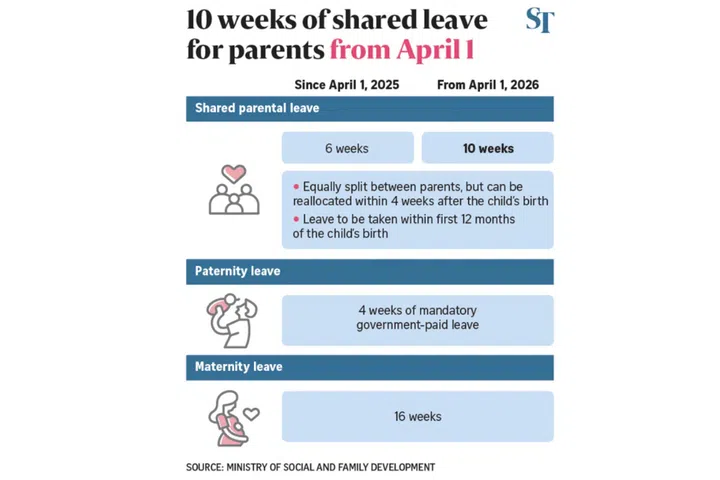
This is because parents were entitled to six weeks of shared leave from April 1, 2025, and will get 10 weeks of shared leave from April 1, 2026.
Q: What is the long and short for a dual-income couple looking to have a baby?
A: Mothers can go on their full 16 weeks’ paid maternity leave.
Fathers will be entitled to four weeks of paid paternity leave.
On top of these, the couple can share between them 10 extra weeks of paid parental leave.
The 10 weeks of shared parental leave will, by default, be equally distributed between the two parents, and both parents can take the shared leave concurrently.
Fathers and mothers can take their shared parental leave at the same time, although they must use their maternity and paternity leave before tapping the shared parental leave. All leave must also be consumed within 12 months from the child’s date of birth (inclusive of date of birth).
These existing requirements still apply: The child must be a Singapore citizen. Fathers who wish to take paternity leave must be lawfully married to the mother of the child.
“Working parents” are defined as those who have served their employer for a continuous period of at least three months before their child’s birth. Self-employed individuals are also counted, as long as they were engaged in work for at least three continuous months before the child is born.
Q: What if one parent wishes to take all 10 weeks of shared parental leave? Is that possible?
A: Yes. Parents are given full flexibility to reallocate their shared parental leave on their own, based on the caregiving arrangement best suited to their families’ needs.
Just make sure that changes to the leave-sharing arrangements are made within four weeks after the child’s birth, so employers get enough heads-up to make the necessary covering arrangements in time. Head to the LifeSG website or mobile application to get this done.
Any changes thereafter will require mutual agreement between parents and their employers. Employers have the discretion to not grant leave requested without sufficient notice, said the National Population and Talent Division (NPTD) of the Prime Minister’s Office.
Q: Must I use up all my shared parental leave in one shot? Can I take it in chunks?
A: It is possible, but the onus is on you to strike an agreement with your employer on your leave arrangement.
In the absence of a mutual agreement, parents are to take their shared parental leave in one block within the first 26 weeks of the child’s birth, with 4 weeks’ notice to the employer. The employer can choose to waive or shorten the notice period.

Q: My child was born before the original EDD on/after April 1, 2026. Will my husband and I qualify for 10 weeks of shared parental leave?
A: Yes, as long as your estimated date of delivery (EDD) is on or after April 1, 2026. It does not matter if your child is eventually born before April 1, 2026. You may still qualify for enhancements. Contact MSF via the form link in your acknowledgement email after completing your child’s birth registration on the LifeSG website.
The full 10 weeks will be given to parents of babies with EDDs on or after April 1, 2026.
Q: I am a single mother. Do I get the enhanced leave provisions as well?
A: Yes. This means you can get up to a total of 26 weeks away from work – 16 weeks of maternity leave, plus 10 weeks of shared parental leave.
If you marry the child’s father within the first year of your child’s birth, both of you can decide how to share the leave.

Q: I am an employer. Who pays for the employee’s absence from work?
A: The pay associated with the four weeks of mandatory paternity leave and 10 weeks of shared parental leave is fully borne by the Government, so the latest set of changes is not expected to drive up business costs.
As for maternity leave, the status quo remains: For mothers expecting their first or second child, the first eight weeks will be paid by the employer, while the rest is paid by the Government. The Government pays all 16 weeks from the mother’s third child onwards.
The Government’s weekly payout is capped at $2,500, or up to about $10,000 a month. There is no change to this. If an employee earns above $10,000 a month, you can consider topping up the difference, but this is not mandatory.
At steady state, when all 10 weeks of the new shared parental leave scheme is fully implemented from April 2026, the scheme will cost the Government around $400 million a year, an NPTD spokeswoman said.
Q: Why is the Government doing this?
A: The Singaporean population is declining fast, with its total fertility rate reaching a historic low of 0.87 children per woman in 2025. This is lower than Japan’s 1.15 (2024) and Australia’s 1.48 (2024), although it is higher than South Korea’s 0.8 (2025) and Hong Kong’s 0.84 (2024).
Yet, Singapore’s parental leave provisions are still significantly shorter than those seen in other countries.
In other developed countries, parents tend to have periods of leave that cover at least one year, usually shared between both parents to encourage shared parental responsibility.
This includes Japan, which allows up to a year of paid time off, although the longer such leave is taken, the lower the proportion of pay covered. In contrast, the parental leave in Singapore is fully paid up for the most part, unless the parent’s pay exceeds the reimbursement cap.
In 2025, South Korea extended parental leave entitlement to up to one year and six months, from one year previously.
Also, the changes are to address poor utilisation rates of the previous shared parental leave, which ate into a mother’s maternity leave, and the additional two weeks of government-paid paternity leave, which employers can grant on a voluntary basis.
A version of this article was originally published on The Straits Times, and appeared here on Aug 20, 2024. Updated on Mar 31, 2026. Additional text: Michelle Lee