NDR 2026: More Childcare Leave For Working Parents With Kids Aged 12 & Below
Parents will get up to 12 days of childcare leave
By Shermaine Ang -
Share this article
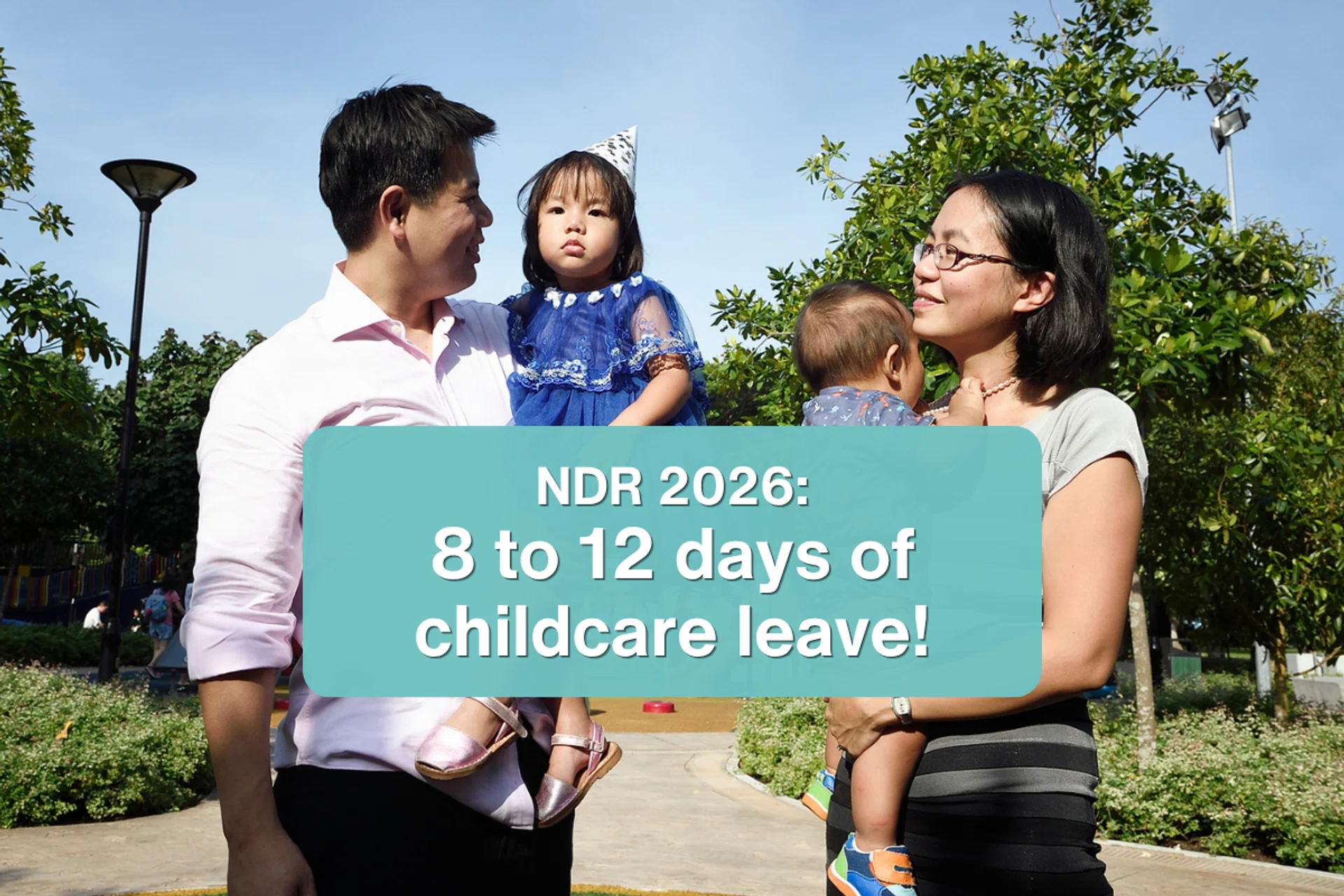
Working parents with children aged 12 and below will get between eight and 12 days of childcare leave a year, depending on the number of children they have.
Those with three or more children in that age group will receive the maximum 12 days, as part of a revamped scheme that will provide more protected time for caregiving through a child’s primary school years.
Prime Minister Lawrence Wong announced the change in his National Day Rally speech on Aug 23, where he spoke of making a “fundamental shift” in how the Government supports families.
“Today, much of our support is concentrated around the birth of a child. Instead, we want to support parents more consistently throughout the journey of raising their children,” he said.
The existing leave schemes will be merged into a single one for working parents with Singaporean children aged 12 and below.
Under the new scheme:
- A working parent with one child aged 12 and below will get eight days of childcare leave a year.
- Those with two children aged 12 and below will get 10 days of childcare leave a year
- Parents with three or more children will get 12 days, which is the maximum entitlement
This means that a couple who are both working and have three or more eligible kids will have up to 24 days between them.
Currently, each working parent gets six days of childcare leave a year when their youngest child is aged six and below. This falls to two days of extended childcare leave when the youngest child is aged seven to 12.
“Many parents tell us this is not enough. Because having more children means greater caregiving responsibilities. And older children still need their parents – the needs are different, but they do not go away,” PM Wong said, adding that parents often end up using their annual leave.
The higher leave provisions are part of a raft of measures aimed at giving Singaporeans greater assurance to start and raise families. These include stronger financial support through a child’s growing years and making pre-school more affordable.
The Government will also reimburse employers for the full duration of all child-related leave schemes, such as maternity leave and childcare leave, up to a limit.
“When we think about what matters most to Singaporeans, family is at the heart of it,” PM Wong said.” That’s why nothing matters more than helping families thrive.”
He said families everywhere are under growing pressure, with young couples worrying about the responsibilities and costs of starting a family, and parents facing a “balancing act” every day between work and family.
“Many also worry about the future their children will inherit, and whether they are doing enough to help them succeed.”
“We are aiming for more than incremental improvements or changes to individual schemes. We want to make a fundamental shift in how we support families,” PM Wong said.
Parents had given feedback that existing leave provisions were insufficient to cover sickness episodes and school closure days, said the National Population and Talent Division (NTPD).
NPTD said the new baseline of eight days would give two working parents enough childcare leave between them to cover mandated pre-school and primary school closure days, with a buffer for unplanned sickness episodes.
The increase is smaller with each additional child as some caregiving needs can overlap, such as school closure days. The entitlement is thus capped at 12 days per working parent.
Merging the two existing leave schemes is also intended to make the system simpler for parents and easier for employers to track.
The higher leave entitlements will also apply to adoptive parents and single unwed mothers.
Reimbursing employers for parental leave
PM Wong said the Government will reimburse employers for the full duration of all child-related leave schemes, including childcare leave and maternity leave, up to a cap. Currently, employers bear part of the cost of maternity and adoption leave for the first and second child, as well as the first three days of childcare leave.
“This will reduce the financial burden on employers,” he said.
The reimbursement will be capped at $500 per day, $2,500 per week, or $10,000 for four weeks.
This will also apply to eligible self-employed persons, who can currently claim compensation for income lost during the government-paid portion of child-related leave schemes.
NPTD said employers should put in place progressive human resource practices, while employees should use their leave responsibly and discuss leave plans early where possible, so that caregiving needs and workplace operations can be managed well.
More details, including when the new childcare leave scheme and changes to reimbursement for child-related leave will start, will be announced later.
Over the years, paid parental leave has been significantly expanded to up to 7 ½ months of government-paid leave today, PM Wong said. This comprises 16 weeks of maternity leave, four weeks of paternity leave and 10 weeks of shared parental leave.
“Can we go further? I won’t rule it out,” he said. “But these leave arrangements have just been introduced, and employers do need time to adapt. So we will let these changes settle in first.”
PM Wong urged employers to support parents, give them confidence to take leave to care for their children and help them settle back into work afterwards.
“Make sure that becoming a parent never becomes a disadvantage in someone’s career,” he said, adding that parents who feel supported are better able to give their best at work.
The Government will continue to engage employers and parents in the coming months to gather feedback on implementation. Updates to legislation and systems are also required.
The measures are the first set of recommendations from the Marriage & Parenthood Reset Workgroup to be accepted by the Government, ahead of its full report in early 2027.
The inter-agency workgroup, chaired by Minister in the Prime Minister’s Office Indranee Rajah, is reviewing issues cited as barriers to marriage and parenthood. These include work-life support, fertility and maternity healthcare, housing, relationship formation and education, on top of child-raising costs and caregiving.
The workgroup was formed in April to support Singaporeans as they navigate marriage and parenthood, aiming to bring about a societal ‘reset’ that gives citizens greater hope to start and raise families. The nation’s total fertility rate fell to a historic low of 0.87 in 2025.
Watch PM Wong’s National Day Rally speech here:

This article was originally published by The Straits Times.