84% of Young Singaporeans Surveyed Want Kids — But There’s A Lack of Fertility Awareness
In a new Thomson Medical-NUS survey, only 10% answered five fertility literacy questions correctly
By Syarafana Shafeeq -

Share this article
Only one in 10 young adults surveyed in Singapore knew the answers to basic fertility questions, despite more than half believing they were well-informed about fertility and reproductive health.
The knowledge gap was also evident among those who want to become parents. Among childless respondents who said having children one day was important to them, 43% answered two or fewer of five questions on fertility literacy correctly.
Most respondents in the Thomson Medical-National University of Singapore study aspired to be parents, with 84% saying they ideally wanted at least one child. About half, or 51%, said their ideal family would have two children, while 16% did not want any children.
The inaugural study polled 1,035 people in June 2026 on their parenthood aspirations, reproductive timing and fertility knowledge. It was led by Reuben Ng, the study’s principal investigator from the Lee Kuan Yew School of Public Policy (LKYSPP).
The respondents, aged 18 to 39, were also asked about their awareness or attitudes towards fertility services.
The average age of respondents was 28.8 years old, and 87% of them were Singapore citizens.
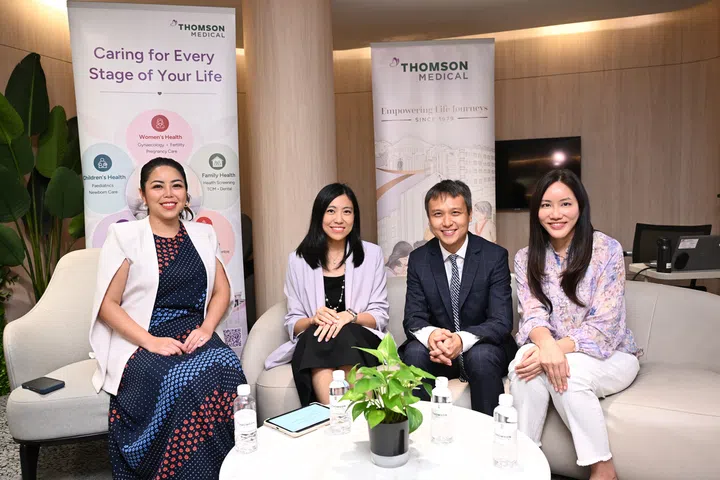
The findings, which were released on Oct 1 at a media briefing, found that while most respondents understood broadly that fertility declines with age, there were gaps in their knowledge of reproductive health.
Four in five knew that a woman’s chances of becoming pregnant naturally decrease as she gets older, while 75% knew that it generally becomes more difficult for both men and women to conceive naturally as they age.
But only 29% knew that ovaries do not continue to produce new eggs throughout a woman’s reproductive years. About 40% answered this incorrectly, while another 30% were unsure.
While 57% correctly identified that men’s fertility declines with age, 19% thought otherwise and another 24% were unsure.
These findings come ahead of a full report by the Marriage and Parenthood Reset Workgroup expected to be ready in early 2027. The inter-agency work group, chaired by Minister in the Prime Minister’s Office Indranee Rajah, was set up to address issues affecting the country’s birth rate, including areas like fertility support.
The Thomson Medical-NUS study also found a gap between some respondents’ preferred timeline for having children and where they were in life.
The most common ideal age to start trying for children is 27 to 29 for women and 30 to 32 for men. Among childless respondents, 22% of women and 25% of men were already older than the upper end of the age range they themselves considered ideal.
Some 40% of all respondents also felt some urgency or pressure around their reproductive timeline.
Awareness of fertility services was also uneven
While 93% of respondents knew of at least one fertility service, awareness was highest for more prominent interventions like in-vitro fertilisation, and egg or sperm freezing.
About 54% were aware of earlier interventions like fertility screening, while 31% knew about intrauterine insemination and 28% about surgical treatments such as polyp or cyst removal.
Researchers said the findings point to a need for fertility support before couples encounter problems trying to conceive.
About 80% of respondents supported financial subsidies for fertility screening, while 79% wanted easier access to assisted fertility care and 78% agreed that more should be done to provide fertility awareness education.
Almost two-thirds, or 64%, wanted tertiary institutions to partner fertility providers on fertility awareness education, while 59% supported similar partnerships with employers.
Cassandra Loh, chief executive of Thomson Medical, said: “Many young adults... deserve clear, trusted and practical fertility information earlier, so that when they are ready to think about family planning, they can do so with greater confidence.”
The survey also found that people’s intentions towards parenthood can change through different stages of life.
Among respondents who recalled being neutral about having children when they were younger, 83% now wanted children. Among those who said they did not want children when younger, half now wanted at least one child.
LKYSPP’s Ng said the findings challenged a simple opt-out narrative around parenthood.
“Most respondents still ideally want children, but parenthood aspirations are not static. Many people move from ‘not sure’ to ‘maybe’ to ‘yes’ as life changes,” he said.
“Thinking can change over the life course, and that’s actually good news for us. Things can change, and people can be nudged towards that,” he added.
The study showed that fertility should be viewed as a decision across a person’s life course, shaped by knowledge, timing, relationships and social context, he added.
Among respondents who had always wanted children and continued to do so, 38% cited the cost of living as having reshaped their expectations, such as by delaying parenthood or having fewer children.
Relationships are also a factor, with 76% of respondents saying it was important for their partner or spouse to share their views on how many children to have.
Around 63% agreed that raising children was one of the most meaningful things a person could do in life, while 67% agreed that life could be just as fulfilling without children.
Loh said fertility education should meet young adults at different life stages, including through schools, workplaces, homes and clinics.
The study called for fertility conversations to start earlier, and healthcare providers to make screening and care options easier to understand before people actively try for children.
This article was originally published on The Straits Times.