Six Of Her Nine Children Have Special Needs
Madam Tahirah Mhd shares her experiences to help other parents and to foster an inclusive Singapore
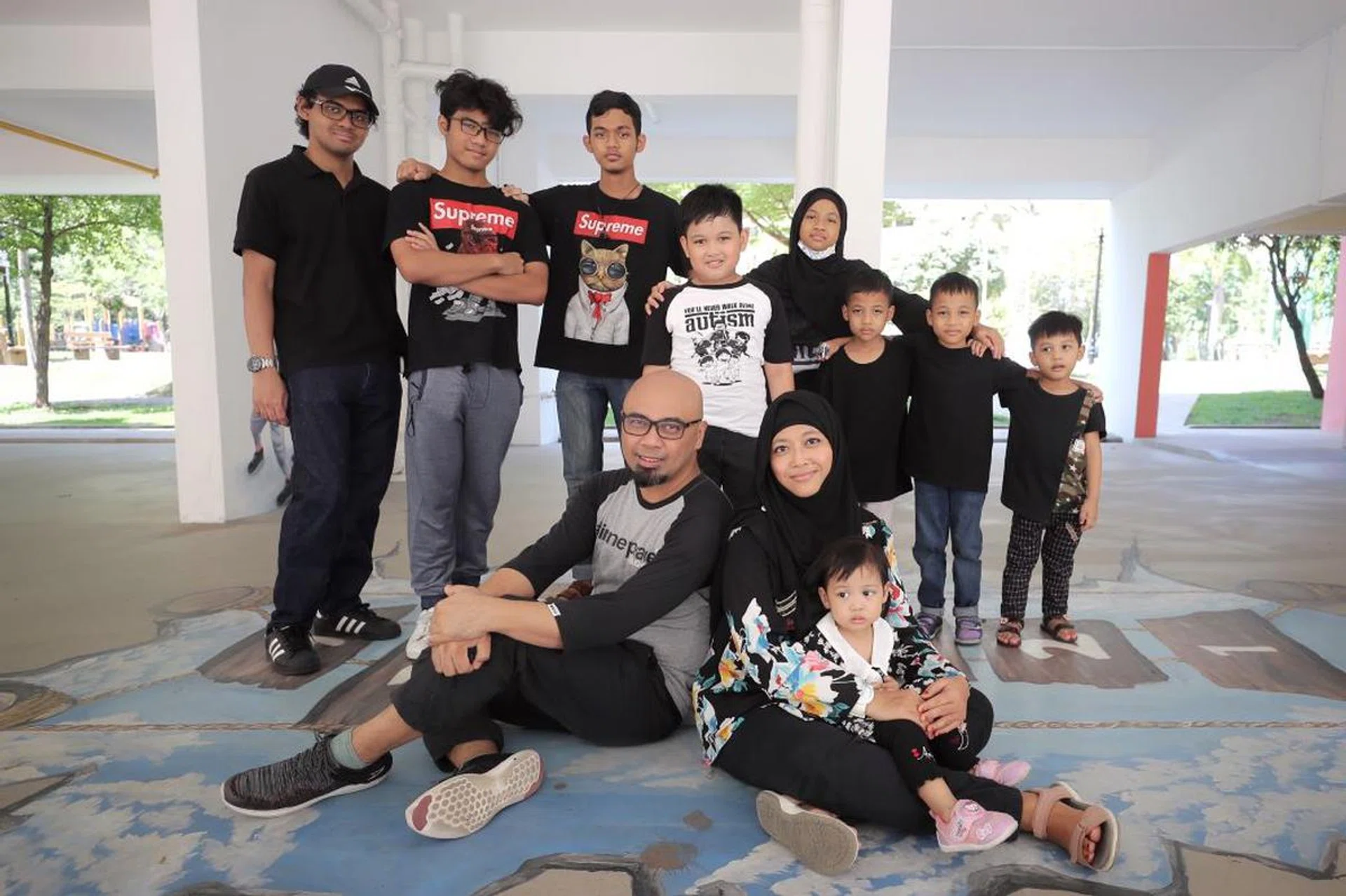
With nine children, aged two to 20, Madam Tahirah Mohamed, 44, has plenty to do. Plus six of her kids have special needs. They have inspired the stay-at-home mother to become an articulate advocate for inclusivity. Her first and fifth children, Muhammad Huzaifah, 20, and Muhammad Talhah, nine, have autism spectrum disorder, while the second child, Muhammad Mu'az, 17, has attention deficit hyperactivity disorder (ADHD). Huzaifah also has obsessive-compulsive disorder.
Her sixth to eighth children, twins Muhammad Ziyad and Muhammad Zayid, seven, and four-year-old Muhammad 'Abbas, have global development delay. This is an umbrella term that refers to significant delays in one or more areas of emotional, mental, or physical growth.
Meeting them for the first time, one cannot help but be impressed by how organised the family is. The older children pair up with their younger siblings during the trek across Tampines Central to find a nice photo spot for this article. It turns out they have been trained to operate on a buddy system. And while posing at an iconic mangosteen-themed playground, the kids are cooperative and well-behaved.
First-born Huzaifah was nine when his unpredictable meltdowns were finally diagnosed as high-functioning ASD, or what was formerly known as Asperger's syndrome.
Reading up on autism provided "relief" and closure
Her initial dreams for her son evaporated and "we found ourselves grieving", says Madam Tahirah, who quit her job as an administrator in 2003 when her second child, Mu'az, was born. Her husband, Mr Noor Irwan Rashid, 44, works as a facilities manager in a postal company.
To temper their anxiety, the couple, who are both avid readers, borrowed books on autism, which provided "relief" and closure. "Then it was time for us to stand up and bounce back quickly to help our son. I have to help myself first before I can help my child," she says.
They did the same when their other kids were diagnosed with other conditions. They also like reading self-help books such as Richard Carlson's Don't Sweat The Small Stuff series to put themselves in a positive frame of mind.
The children are taught life skills like cooking, to foster independence
Madam Tahirah says, "I believe that children are our best teachers. No matter what you want to do, you are forced to learn how to extend your patience, take a step back and look at the bigger picture".
The couple believes in empowering their children with life skills, so they learn to help themselves from an early age. By age seven, each child knows how to iron his or her school uniform, and even two-year-old Zinnirah has started clearing her plate after meals.
"If you don't equip your children with skills, they may not feel worthy. It can also be therapeutic for them, like when Huzaifah learned to cook nasi goreng and said, 'I feel much better.' It's the process of starting from nothing to making something and you serve it to your whole family," she says.
Trips to favourite haunts like Jewel Changi Airport and the beach via public transport may seem like a logistical challenge, but Madam Tahirah has a well-honed plan, even if she has to lead her brood alone. She briefs the older kids on safety precautions (such as minding the gap at the MRT platform), and they then instruct the younger ones. She also reinforces the message with visual reminders on WhatsApp.
In between her many daily chores - she says she clocks about 10,000 steps a day - she treasures "bite-sized, self-care" moments, from a slow walk in her neighbourhood park to taking her time while shopping for groceries.
Madam Tahirah is the main caregiver, so she takes her children to and from school and to intervention centres run by charities such as SPD and Rainbow Centre. She says she is sometimes exposed to "all the rude stares" from strangers. Instead of ignoring them, she uses these encounters to educate people about her children's "invisible disorders".
"I take it as an opportunity to share that my son has this and this. He's born with it, he's wired differently," says Madam Tahirah, whose 67-year-old mother helps look after her kids when she has to run errands. The family, who live in a four-room flat, have no helper.
The couple share their experiences with other parents to "give back."
She and her husband - who calls her his "BFF or best friend for life" - have also shared their experiences with other parents on various platforms, such as support groups, as a way to "give back". She says, "There are many parents who have children with special needs, but not many are willing to be vulnerable and put themselves out there," she says.
Last month, they were invited to share their thoughts in a webinar for parents with babies and pre-schoolers, the first in a series of Government-initiated conversations on the theme "Building a Singapore that is Made for Families". Ms Indranee Rajah, Minister in the Prime Minister's Office and Second Minister for Finance and Second Minister for National Development, led the event.
Madam Tahirah also uses her Facebook page as an advocacy platform, posting nuggets of information and inspiring messages about special needs and mental health, such as pointing out that an autistic meltdown is not a typical temper tantrum or the result of bad parenting. "Let's move on from awareness to acceptance," she says.
Madam Tahirah's openness has not always been well received, with some members of her extended family asking her why she is not ashamed about sharing her experiences?
She says, "Why should I feel ashamed? I'm talking about my loved ones. It's also part of my healing. It's how I process the sadness and whatever we went through as a family. Through sharing, people show you empathy and kindness, and you draw strength from there."
Her inner strength is something her eldest son Huzaifah, who is studying green building and sustainability at a polytechnic, pays tribute to. Asked what he loves about his mother, he says immediately: "Her sacrifice. She tries her best to create time for every child to make sure they're doing okay."
By Stephanie Yeo, This article first appeared in Straits Times