Why Teeth Can Start To Look Discoloured – Even When You Brush Regularly
Your morning coffee and afternoon snack may be doing more than satisfying cravings – the acids they leave behind can slowly erode enamel over time
By The Singapore Women's Weekly -
Share this article
Between work deadlines and tending to the kids, dental checkups are easy to postpone. A little sensitivity here, some bleeding when you brush there – nothing that feels urgent enough to carve out time for.
But here’s what many busy Singaporeans don’t realise: One in three Singaporeans aged 21 and older are already living with untreated tooth decay, according to a 2019 National Adult Oral Health Survey.
Part of the challenge is that early symptoms are often ignored. “Most people wait until it hurts to see a dentist,” says Dr Daylene Leong, periodontist at Specialist Dental Group.
“Untreated tooth and gum problems could lead to multiple issues such as decay, enamel erosion, tooth sensitivity, severe infection and potential tooth loss.”
As a result, preventive care has become an increasingly important focus in oral health, with growing attention placed on how everyday oral care habits can help slow or prevent the progression of dental problems.
What is demineralisation?
We’ve all heard of the word demineralisation when it comes to oral health, but what exactly happens to our teeth?
When we eat, the food residue leaves behind a sticky deposit on our teeth called plaque. An article on HealthHub explains that when this layer builds up, bacteria converts sugars and carbohydrates in food particles into acids that dissolve minerals on the tooth surface. This erodes enamel and forms dental cavities.
This process, where minerals on the tooth surface dissolve, is called demineralisation. And it causes tooth decay.
That’s when we might see discolouration on the teeth. As tooth decay progresses, the protective enamel is penetrated, exposing the inner layers of the tooth. This softer dentin and tooth pulp contains nerve fibres and when they are exposed or affected by decay, it can result in tooth sensitivity or toothache.
Explains Dr Leong: “Teeth discoloration can be a sign of loss of enamel, exposing the inner dentine layer. This happens when teeth are exposed to acids from certain foods and drinks.
“As we age, with time, gum problems, teeth sensitivity or enamel erosion can commonly happen as these issues build up over time and are not arrested in a timely manner.”
Toothpaste with all-round protection
Like a strong wall, enamel forms the protective hard outer layer on our teeth. Dr Leong says it is the first line of defence that protects our teeth from damage, stressing the importance of fluoride for its ability to help prevent tooth decay.
In between your regular six-month dentist visits, fluoride becomes the reinforcements for this enamel wall, playing a key role in supporting teeth remineralisation and helping to keep decay at arm’s length.
“Fluoride is a natural mineral that helps strengthen your teeth. Think of it as a repair crew for your enamel. The more fluoride content in your toothpaste, the better,” says Dr Leong.
“Hence, a toothpaste with a high fluoride content of 1,450 to 1,500 parts per million (ppm) can better support remineralisation and help prevent tooth decay than those with lower concentrations.”
However, fluoride is just one soldier in the entire arsenal against tooth decay.
Adds Dr Leong: “For added protection, you may want to look for a toothpaste with a high retention formula. This means it can help retain fluoride on the tooth, forming a protective layer for long-lasting cavity defence.
“Lastly, ensure you visit your dentist regularly so that periodontal disease and dental caries can be treated and arrested early so you don’t end up having more complex, costly and painful conditions.”
Products such as Clinica Pro Toothpaste from Lion Corporation – Japan’s number one oral care company1 – are formulated with these considerations in mind.
Clinica Pro Toothpaste – from the number one toothpaste brand in Japan2 – contains 1,450 ppm of fluoride and uses a high fluoride retention formula to maximise protective benefits.
In addition to delivering fluoride fortification, Clinica Pro Toothpaste’s formula leaves a coating agent – like a shield – on tooth enamel. This helps to keep fluoride on the tooth surface, helping to protect against the onset and progression of cavities.
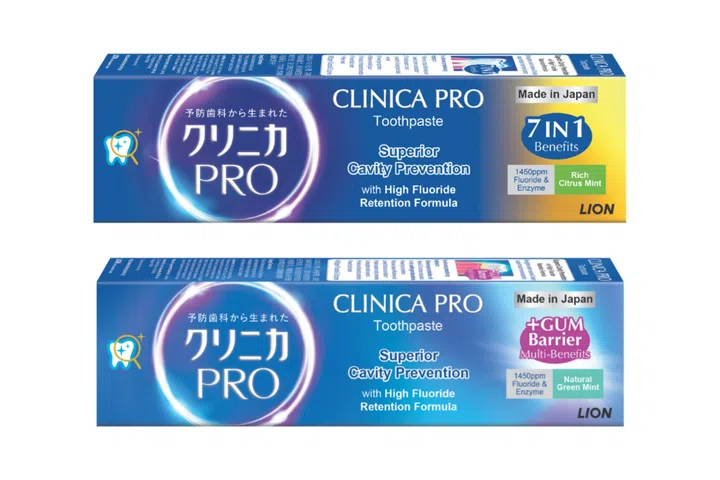
Clinica Pro Toothpaste is available in two variants – the 7-in-1 Benefits version supports all-round protection, whereas the +Gum Barrier Multi-Benefits version offers enhanced gum protection.
Clinica Pro Toothpaste is available in two variants. The 7-in-1 Benefits version supports all-round protection, including plaque removal, anti-bacterial protection, strengthening teeth enamel, preventing bad breath and protecting against gum problems. It is also said to help whiten teeth and relieve pain from sensitivity.
The +Gum Barrier Multi-Benefits version offers enhanced gum protection and includes vitamin E and licorice root extract to help soothe gum discomfort.
Clinica Pro Toothpaste (7-in-1 Benefits/+Gum Barrier Multi-Benefits) is available at leading supermarkets and retail outlets in Singapore, at $9.95 (95g tube).
Footnote:
1 INTAGE SRI+, No.1 Company in Oral Care Category, Value Sales, CY2024.
2 INTAGE SRI+, Toothpaste Category, Unit Sales, CY2024.