“Our 0.87 Fertility Rate Isn’t A Women’s Problem, It’s A Time-Protection Problem”
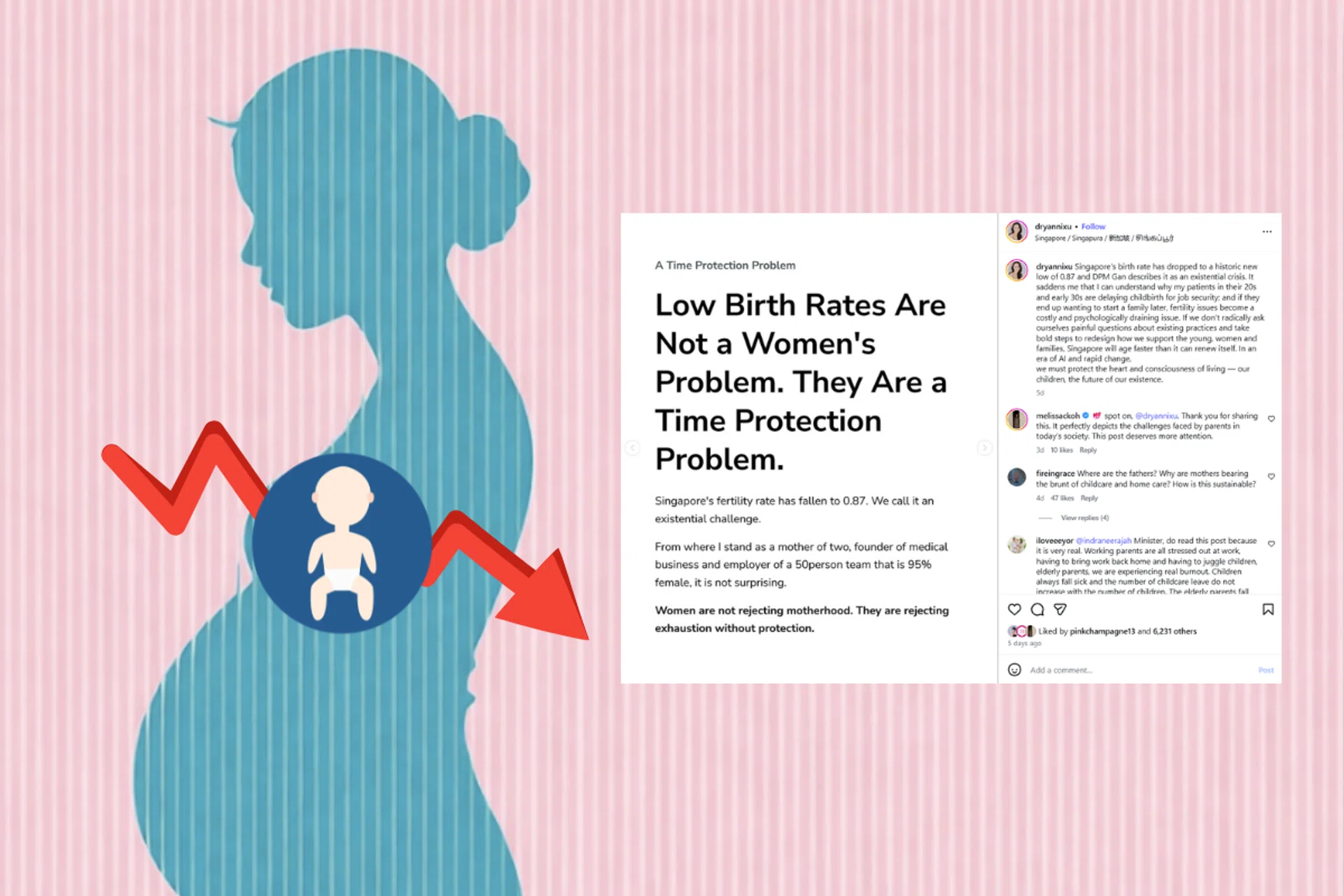
Singapore’s record-low TFR has sparked a wave of discussion — and this Singaporean doctor and mum of two has gone viral for her honest take on the issue
By Balvinder Sandhu -
Share this article
Singapore is currently in a population crisis. Figures released last week showed our resident total fertility rate (TFR) in 2025 was at a historic low of 0.87.
The TFR refers to the average number of babies each woman would have during her reproductive years. The rate should be around 2.1 to sustain a country’s population size (aka the replacement rate). With a rapidly ageing population, our citizen population may start to shrink by the early 2040s, if nothing is done.
As a Singaporean, that statistic feels a little startling. People are the main resource in our country. But for parents in Singapore, it’s not surprising news. Having a child is an expensive investment, and with other issues like possible career stagnation and burnout, it’s no surprise that women are electing to have fewer children — or none at all.
The solution, obviously, isn’t as simple as ‘have more babies’. So what are our options?
One mum has gone online to share her candid take on the whole situation. Dr Yanni Xu, a Singaporean aesthetic doctor and entrepreneur, recently went viral on Instagram, calling out the root of the problem: women simply don’t have enough time.
In Yanni’s post, she said she understands why her patients in their 20s and early 30s are delaying childbirth for job security. And, if they end up wanting to start a family later, fertility issues become a costly and psychologically draining issue.
“If we don’t radically ask ourselves painful questions about existing practices and take bold steps to redesign how we support the young, women and families, Singapore will age faster than it can renew itself. In an era of AI and rapid change, we must protect the heart and consciousness of living – our children, the future of our existence,” she posted.
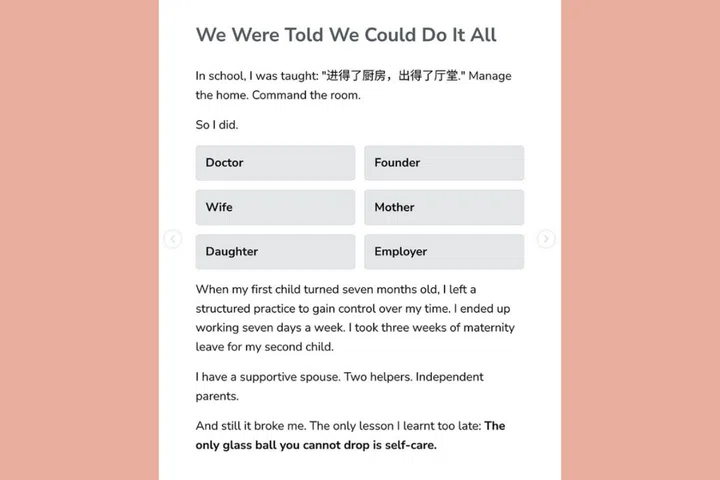
The mum of two went on to say that “women are not rejecting motherhood. They are rejecting exhaustion without protection”. Women are told we can ‘do it all’ but is this actually possible?
Yanni lists her roles – doctor, founder, wife, mother, daughter, and employer. She has a supportive spouse, two helpers and independent parents. She wakes up at 6am, preps the kids for school, and only returns home at 8pm after work, on top of helping with homework, revisions and keeping up with parent-teacher communication platforms. Yet she finds it hard to juggle all these balls and keep them from falling.
“Still, it broke me,” she said. “The only lesson I learnt too late – the only glass ball you cannot drop is self-care.”
But do mums have time for self-care? Many women in Singapore are also in the “sandwich generation” – caring for young children as well as elderly parents.
Yanni also cited “time protection” as the main reason for our low birth rates. As an employer, she has seen her team through various life phases and offers perks such as flexible hours, sabbatical leave, parent-care leave and time off during PSLE and sick-child periods. She also hires women re-entering the workforce after long career breaks.
If we want more children in Singapore, aren’t these the type of perks every company should offer?
Women are refusing burnout
Yanni’s suggestion to help our declining population is to “make birth rate the national North Star”. This means our solution should come from various angles. Low fertility shouldn’t be seen in a vacuum – nor should low birth rate be a statistic we react to.
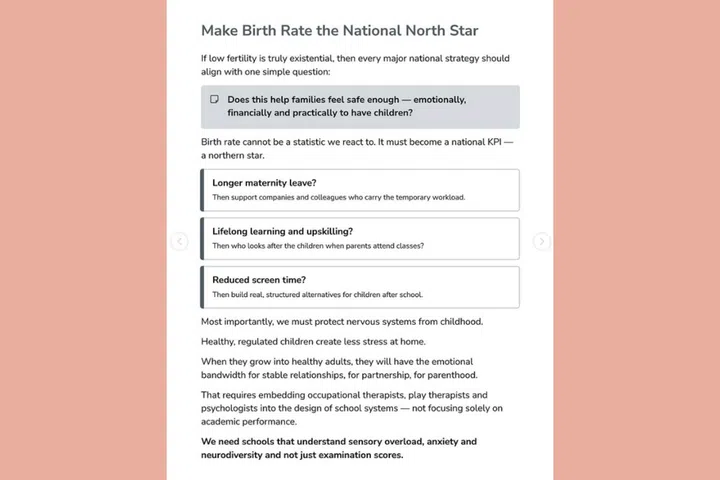
If we want to mandate longer maternity leave, we also need to support the companies and colleagues who carry the temporary extra workload. If we want to encourage lifelong learning and upskilling, who is going to look after the children while their parents are at these classes?, she pondered.
She also touched on the topic of screen time. If we want to reduce kids’ screen time, then we need to build structured, after-school alternatives for children. Because, as Yanni mentioned, parents are working full-time, while children are done with school at 1.30pm. Systemic support is needed to fill these gaps taken by screen time at the moment.

Her post resonated with many parents, especially mums. Many applauded Yanni for voicing her opinions and agreed with her thoughts.
Some even tagged Dr Indranee Rajah in their replies. Dr Indranee is the Second Minister for Finance and National Development, and will be chairing a new work group with several agencies, to look into marriage and parenthood issues.
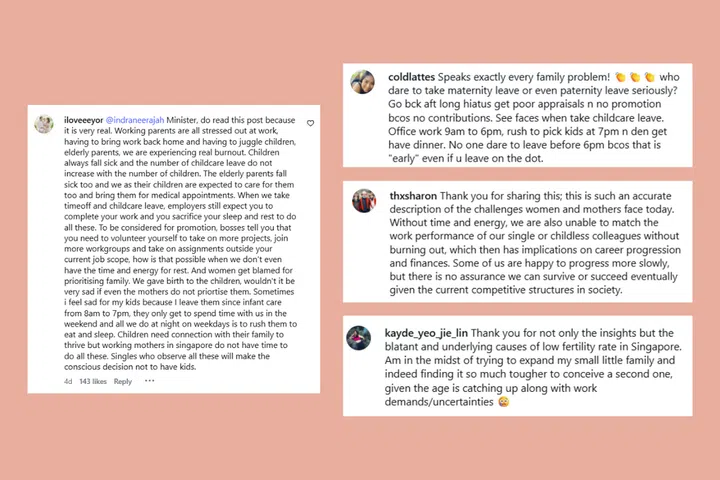
@Iloveeeyor said: “Minister, do read this post because it is very real. Working parents are all stressed out at work, having to bring work back home and having to juggle children, elderly parents, we are experiencing real burnout.”
After explaining how employers still expect mums to complete their work when they take time off and childcare leave – thus having to sacrifice sleep – she also mentioned how women are blamed for prioritising family.
@Coldlattes agreed with Yanni’s points and offered her opinion: “Who dare to take maternity leave or even paternity leave seriously? Go back after long hiatus get poor appraisals and no promotion because no contributions.”
The very real possibility of burnout is also a big put-off for women who don’t have children, @Iloveeeyor added: “Children need connection with their family to thrive but working mothers in Singapore do not have time to do all these. Singles who observe all these will make the conscious decision not to have kids.”
Parenting subsidies should go further
There is also the fact that perks like baby bonuses aren’t sufficient in supporting parents.
@Jesskwa commented: “Without stronger support beyond birth incentives, like more generous paid childcare or caregiving leave, indexed to the number of kids, it’s no surprise many parents still struggle to balance work and family.”
Perhaps another angle to consider is how fertility treatments are offered because there are couples who desperately want children but can’t afford the costs. While subsidies do exist, they should go further – and perhaps also not penalise Singaporean women with non-citizen spouses as these subsidies are lower. After all, marriages between such couples are not exactly rare these days.
And how about leave allowances too, for couples to attend these medical appointments? As someone who went through fertility treatments, they can be extremely gruelling and getting time off work will lower stress levels and encourage more couples to try to have children.
Of course, fertility treatments are not always the answer. Many couples get their happy ending and become parents but the statistics show the bigger picture – the chance of having a live birth could be under 50%, and much lower as a woman gets older. So voluntarily delaying pregnancy because fertility treatments will help when you’re older is not the right mindset to have.
And, to go back even further, women’s health should be given more priority, too
There has been progress in the last decade or so, but we need more education on issues such as endometriosis and polycystic ovarian syndrome (PCOS), so women are encouraged to get help sooner if they want to have children.
Parenting is a full-time job. It takes a village to raise a child and this shouldn’t just refer to extended family, friends and caregivers. It should also involve governments and employers.