
How To Get Started With The Montessori Method At Home
Not sure where to start? Here are some commonly-asked questions and practical tips to try
By Vanessa Tai -
Share this article
If you're a parent searching for a good preschool for your child, you’re likely to already have come across the Montessori method. Developed by Maria Montessori at the turn of the century, the Montessori method is now synonymous with holistic learning, nurturing not just the academic prowess of children but also their creativity, independence and social skills. It's now getting more popular among parents, thanks to social media.
But what exactly is it? Jasmine Ong, the founder of parent coaching platform Three Minute Montessori, says, “Montessori is a renowned education method, but it's also a way of life, based on respect for the child and belief in their potential.”

Jasmine, founder, Three Minute Montessori, has worked with over 2000 clients.
She adds, “As a mother who's raised three children the Montessori way, I can tell you what it looks like: children who continue to love learning no matter which school they're in, and who are creative, calm and independent.”
Curious to try out the Montessori method? Here are some common questions addressed, and practical ways you can incorporate this revered philosophy into your home.
Why Montessori?
In a world divided between play-based learning and rigorous academics, Montessori stands as the perfect balance. It integrates sensory experiences with strong academic outcomes, fostering a deep love for learning while ensuring a solid educational foundation. The hands-on learning approach, facilitated by specially designed materials, cultivates essential life skills such as concentration, coordination and logical thinking.
Will my child be losing out if they don’t attend a Montessori school?
You might have come across preschools and childcare centres with "Montessori" in their names, often with price tags that are significantly higher than their seemingly ordinary counterparts.
Ong is adamant that your child does not need to attend a Montessori school in order to reap the benefits of the Montessori education method. In fact, it’s important to note that because the term Montessori has not been patented, it has led to some schools misusing the term while not actually practising traditional Montessori principles.
“The majority of my parenting clients do not send their children to Montessori schools, for valid reasons like cost or distance or lack of authentic schools,” Ong says. You can, however, attend a parenting course and learn how to incorporate the method at home — these don't have to require a lot of prep.
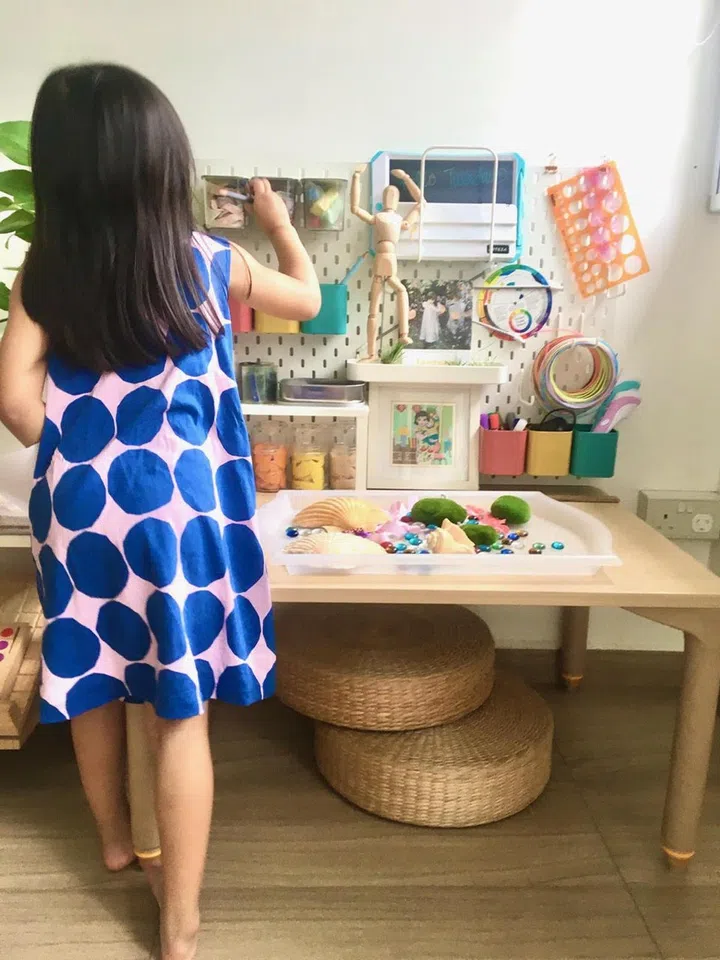
Jasmine’s top tip for living in a small space is to go vertical. This IKEA Sladis pegboard can be fastened onto a table (no drilling needed!) and organises supplies more neatly and invitingly than a box.
Creating a Montessori home environment
Cultivating a Montessori-inspired home means focusing on key areas like practical life activities, multi-age socialisation and unstructured exploration. These activities not only enhance concentration and creativity but also instil a sense of independence in children.
Here’s how to get started:
- Practical life skills: Involve your child in daily activities like cleaning, cooking and organising. For instance, a toddler may be able to wipe their high chair tray or unload the washing machine. A preschooler may be able to fold clothes and arrange flowers. A primary school-aged child can clean their room and cook an egg. These tasks not only enhance their motor skills but also instil a sense of responsibility and independence.

A three-and-a-half-year-old cooking on a Bruno electric hotplate
2. Multi-age socialisation: Encourage regular interactions with people of different ages, which helps to foster a sense of community and empathy. These interactions can occur within the family, with neighbours, or through carefully chosen playdates. “Before I became a mum, I assumed I'd have a built-in village consisting of grandparents,” Ong says. “Like many other parents, I realised that I was mostly alone, so I created an unlikely village – couriers, kindly neighbours, babysitters, a domestic helper and school teachers. All of this has enriched my children's social lives.”
3. Unstructured Exploration: Provide ample opportunities for outdoor exploration, artistic expression and musical endeavours. Let your child's curiosity guide them, allowing them to choose activities freely. Embrace the occasional "I'm bored" as an opportunity for your child to explore their interests independently.
By incorporating these elements into your daily routine, you're not just enriching your child's environment; you're nurturing a lifelong love for learning and self-discovery.
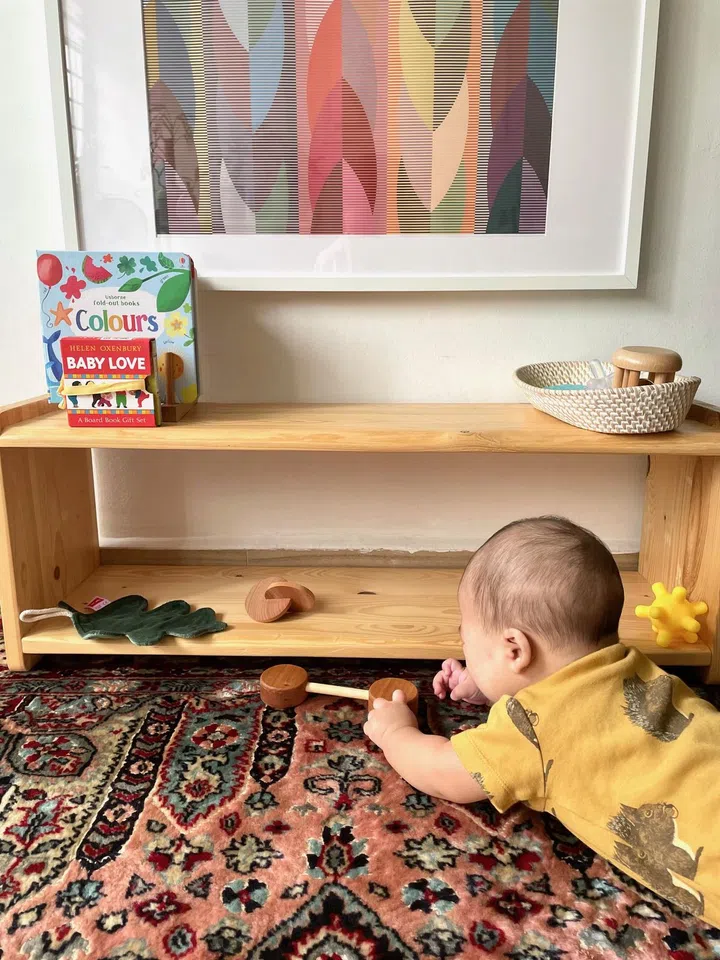
A Montessori shelf for a baby is easy to set up – a few simple toys on a low shelf can encourage deeper and more focused concentration, while allowing free access and movement.
Montessori at home: A journey for all ages
Acknowledging the changing needs of growing children, Ong emphasises that adapting the approach to each age group is crucial, ensuring a tailored and effective learning experience.
“Montessori observed that children change every three years, and therefore our approach must shift to meet their needs and interests. While the principles will be the same throughout, each age group requires a different set of materials, space setup and even socialisation,” she says.
As parents, we hold the key to unlocking our child's full potential. Montessori isn't just a method; it's a philosophy that empowers children to become confident, independent and inquisitive individuals. By embracing the core principles of Montessori at home, we create an environment where our children can thrive academically, socially, and emotionally.